Feb 07 23
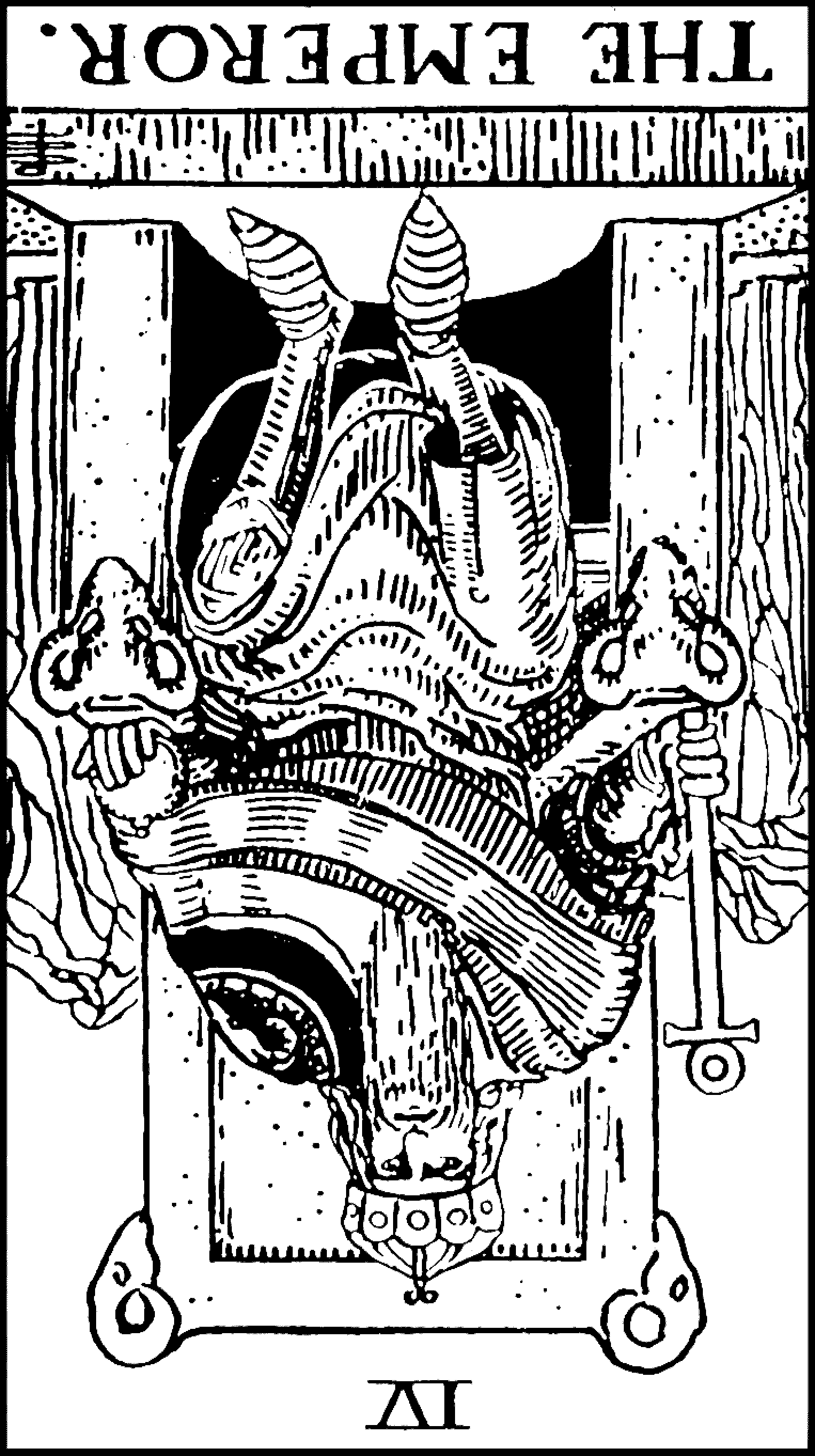
The Emperor (reversed)

22. Grace
18. Work on what has been spoiled [Decay]
These first few lines are the general aphoristic returns for the week. They are raw and uninterpreted; there to use how you’d like. (The specific readings follow.)
From “F.M.”: All around me it seems that my friends and coworkers’ outlooks are hardening into beliefs, whereas I become a person of more and more questions. I am committed and sincere about participating in my various communities, but they seem less and less inclined to allow for open curiosity. I would like some advice on whether my feeling is “true” that people should have more questions than answers (or beliefs). Thanks.
If you are a sensitively and sincerely curious person you can’t allow yourself to be taken in by the veneer of chaos. This life/universe, or whatever you want to call all this stuff, is beyond mere understanding. This is true, even for you, as regards your understanding of other people. Their puerile and narcissitic views, at the end of the day, are something, just as much as a cypress tree and a coke can are something. If you are perceiving that you understand them, you are suffering from what you are accusing them of: belief.
So, you must be careful not to despise anything — though you should not encourage what you think is undignified or stupid. Try to remove yourself and be like the sage and work on creating “incomparable human values for the future.”
If you stay in these stagnating environs you will only be “guilding your impotence” (or worse).
(And remember, it is more than likely, that you have been preceded by better minds in worse times.)
Complete Reading
This week we pulled the Emperor (reversed). When upright the appearance of the emperor points to stability and discipline — of the good necessary kind. When the card arrives in reversed aspect, as it is here, the signification is that disorder and instability are present — think bureaucracy or martial law.
Our first hexagram this week is #22, Grace. The aestheticizing of a task or situation should not be the fundamental preoccupation: “…at the highest stage of development all ornament is discarded… perfect grace consists not in exterior ornamentation of the substance, but in the simple fitness of its form.” The “beauty of form—is necessary in any union if it is to be well ordered and pleasing rather than disordered and chaotic” however “it is not the essential or fundamental thing; it is only the ornament and therefore to be used sparingly…” In summation, valuing beauty is fundamental in all endeavors, but thinking beauty to be the main or only thing to consider, can lead to catastrophe — a beautiful surface can mislead if other depth examinations aren’t appraised. There were two changes this week, of which the specific notes are: don’t take an easier way, take the surer way and do not ignore causation for beauty (do not be taken in by appearances).
Our second hexagram, the one that suggests how best to meet the challenges (or the changes) is #18, Work On What Has Been Spoiled (Decay). There is stagnation and corruption — a contaminated torpor caused by some sort of ennui or malaise. There is need to begin again. Initiate this by drumming up all the good aspects of life (that is, partaking in that which brings one healthy joy and “casting out all that is degrading”). Regularize these beautiful aspects of life into an oft tended rhythm — a project. Remember “what has been spoiled through one’s fault can be made good again through one’s work.” However if the cause is mostly external, a disengagement with the short term and topical may be necessary: “such withdrawal is justified when we realize in ourselves the higher aims of humankind… for although the sage remains distant from the turmoil of daily life, they create incomparable human values for the future.”
- beware of bureaucracy/chaos born of fallen leadership
- push for the common good despite the momentum of the crowd
- do not be taken in by the surface of things, preoccupy yourself with truer causation(s)
- refresh a stagnated situation with a return to all that is mentally and physically healthy
- if necessary, it is ok to depart/retreat from topicality and the unproductive chaotic energy of short term thinking, to work on the above (in project form)
From “F.M.”: All around me it seems that my friends and coworkers’ outlooks are hardening into beliefs, whereas I become a person of more and more questions. I am committed and sincere about participating in my various communities, but they seem less and less inclined to allow for open curiosity. I would like some advice on whether my feeling is “true” that people should have more questions than answers (or beliefs). Thanks.
If you are a sensitively and sincerely curious person you can’t allow yourself to be taken in by the veneer of chaos. This life/universe, or whatever you want to call all this stuff, is beyond mere understanding. This is true, even for you, as regards your understanding of other people. Their puerile and narcissitic views, at the end of the day, are something, just as much as a cypress tree and a coke can are something. If you are perceiving that you understand them, you are suffering from what you are accusing them of: belief.
So, you must be careful not to despise anything — though you should not encourage what you think is undignified or stupid. Try to remove yourself and be like the sage and work on creating “incomparable human values for the future.”
If you stay in these stagnating environs you will only be “guilding your impotence” (or worse).
(And remember, it is more than likely, that you have been preceded by better minds in worse times.)
Complete Reading
This week we pulled the Emperor (reversed). When upright the appearance of the emperor points to stability and discipline — of the good necessary kind. When the card arrives in reversed aspect, as it is here, the signification is that disorder and instability are present — think bureaucracy or martial law.
Our first hexagram this week is #22, Grace. The aestheticizing of a task or situation should not be the fundamental preoccupation: “…at the highest stage of development all ornament is discarded… perfect grace consists not in exterior ornamentation of the substance, but in the simple fitness of its form.” The “beauty of form—is necessary in any union if it is to be well ordered and pleasing rather than disordered and chaotic” however “it is not the essential or fundamental thing; it is only the ornament and therefore to be used sparingly…” In summation, valuing beauty is fundamental in all endeavors, but thinking beauty to be the main or only thing to consider, can lead to catastrophe — a beautiful surface can mislead if other depth examinations aren’t appraised. There were two changes this week, of which the specific notes are: don’t take an easier way, take the surer way and do not ignore causation for beauty (do not be taken in by appearances).
Our second hexagram, the one that suggests how best to meet the challenges (or the changes) is #18, Work On What Has Been Spoiled (Decay). There is stagnation and corruption — a contaminated torpor caused by some sort of ennui or malaise. There is need to begin again. Initiate this by drumming up all the good aspects of life (that is, partaking in that which brings one healthy joy and “casting out all that is degrading”). Regularize these beautiful aspects of life into an oft tended rhythm — a project. Remember “what has been spoiled through one’s fault can be made good again through one’s work.” However if the cause is mostly external, a disengagement with the short term and topical may be necessary: “such withdrawal is justified when we realize in ourselves the higher aims of humankind… for although the sage remains distant from the turmoil of daily life, they create incomparable human values for the future.”