Jul 23 24
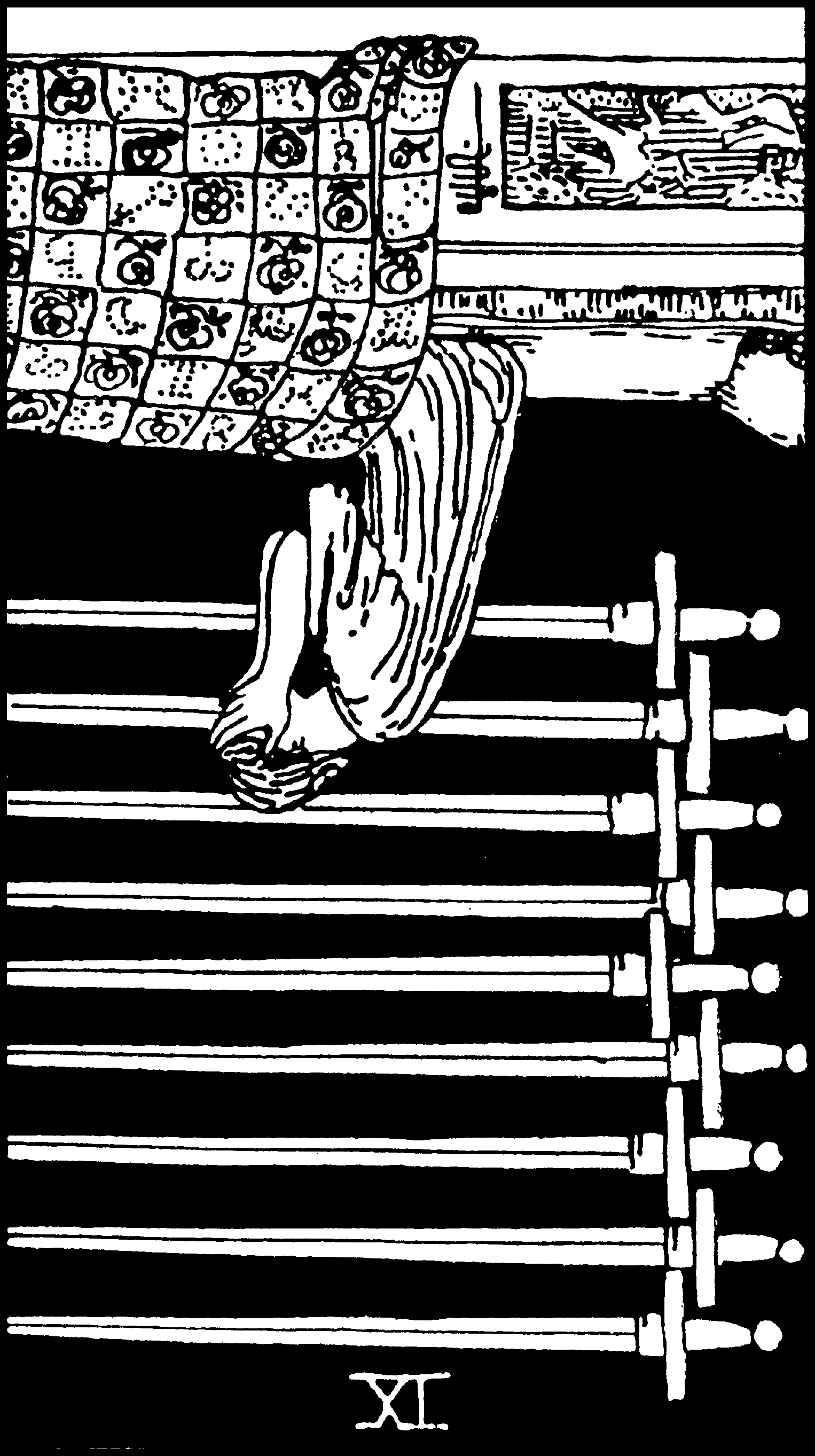
Nine of Swords (reversed)

19. Approach
26. The Taming Power of the Great
These first few lines are the general aphoristic returns for the week. They are raw and uninterpreted; there to use how you’d like. (The specific readings follow.)
From “M.S.”: There is clearly no right answer or right thing, as far as human knowledge and action are concerned. That is, like one couldn’t properly say that the wearing of fake eyelashes is a right decision, as such items are involved (like most mechanically produced consumer products) in labor and environmental activities thoroughly dicey. But on the other hand, if there were two friends who enjoyed wearing fake eyelashes (etc.) together, as a fun activity, and one of the friends died and subsequently, the remaining friend, on occasion, wears fake eyelashes to keep happy memories of the deceased friend alive — most would say that is a lovely thing to do.
Therefore, rightness and wrongness is contextual.
But that seems ultimately too loose, like leaving it there just leads to everybody just rationalizing any activity or decision claiming vague context. Not having some sort of moral code or ethical aspiration seems plainly destructive, personallyand generally (as well, we say this not religiously or dogmatically, but purely secularly). So, combining those two notions: “that there is no right thing” with “one needs an ethical foundation/aspiration” to be relatively healthy/sane-ish... the best rule we’ve been able to come up with is that we should all TRY to do the right thing. That is NOT to DO the right thing (because obviously, as said it is impossible, as rightness is unstable and contextual). So, yes, TRYING to do the right thing seems the only thing to do. (Also, without trying all humanity is lost.)
What does the oracle have to say about this notion that humans should always TRY to do the right thing?
It seems that you are pointing out the difference between belief/surety and experimentation/attempt. Yes, true belief is of course impossible. Striving and experimenting is really the only way for us humans. But, knowledge/education should be attached to the latter. Experimenting whilst doing your best to log the results but also studying the past (both personally and historically) and then applying the results.
So, agreed, no simple do the right thing. But yes, rather, always try to do the right thing which should be comprised of open experimentation and the application of deep/committed education (studying the success’ and failures of the past).
Also to note, when trying to do the right thing it would be wise to exercise restraint, nurture communal cohesion and allow yourself to be genuinely caring. Charm helps too.
Complete Reading
This week we pulled the Nine of Swords (reversed). This is a dark card to be sure. When upright the intimation is of being amidst a nightmare. When reversed, as it is here, the feeling is that of being in the shadow of a nightmare — the fallout of trouble. But returning to a less unnerving state is possible, with present and responsible integration.
Our first hexagram this week is #19, Approach. The “approach” here is that of Spring approaching from the vantage of winter’s end. That is, the end of a difficult time into a more favorable one. These moments are to be enjoyed and celebrated, but since the seasons (and many activities generally) are cyclical, having fairly known/standard ups and downs, one shouldn’t revel too much, but incorporate fall and winter-esque times into their enjoyment of easier times. All is healthier and more stable this way. “If we meet evil before it becomes reality—before it has even begun to stir—we can master it.”
There were two changes this week, of which the specific notes are: do not let success relax you (vigilance is an attitude necessary for ALL manner of times) and it is a wonderful thing when a sage (withdrawn wise person) returns to the world of people and helps them.
Our second hexagram, the one that suggests how best to meet the challenges (or the changes) is 26, The Taming Power of the Great. (Note: we say this fairly often, but it bears repeating, if a metaphor is aimed at a leader of a group, and you are not such a leader, being primarily solo, the lesson can still apply, as there are many aspects of self that need strong, singular leadership.) Here, great responsibility is broken into three necessary elements: that of “holding together”, that of “caring and nourishing” and finally of “holding back” (restraint). It is said that such a person is likely rare and something of a sage. Such a person needs to be “strong and clear–headed” and have this “ light and clarity” as the center of a “daily renewal of character.” As well, such a person needs to “study the past” but not simply mere learning (of history, etc.) but to “apply this knowledge.” Learning, ultimately, is only as good as its implementation.
- The lingering effect of traumatic or unnerving times can be relieved with responsible integration.
- Don’t be short sighted in a favorable time. Don’t let success relax you (vigilance is an attitude necessary for ALL times).
- Learning, ultimately, is only as good as its application. Get out there!
- To properly/significantly lead you must have the following three qualities: restraint, a desire for communal cohesion (and the personality/charm to do so) and be genuinely caring and nourishing.
From “M.S.”: There is clearly no right answer or right thing, as far as human knowledge and action are concerned. That is, like one couldn’t properly say that the wearing of fake eyelashes is a right decision, as such items are involved (like most mechanically produced consumer products) in labor and environmental activities thoroughly dicey. But on the other hand, if there were two friends who enjoyed wearing fake eyelashes (etc.) together, as a fun activity, and one of the friends died and subsequently, the remaining friend, on occasion, wears fake eyelashes to keep happy memories of the deceased friend alive — most would say that is a lovely thing to do.
Therefore, rightness and wrongness is contextual.
But that seems ultimately too loose, like leaving it there just leads to everybody just rationalizing any activity or decision claiming vague context. Not having some sort of moral code or ethical aspiration seems plainly destructive, personallyand generally (as well, we say this not religiously or dogmatically, but purely secularly). So, combining those two notions: “that there is no right thing” with “one needs an ethical foundation/aspiration” to be relatively healthy/sane-ish... the best rule we’ve been able to come up with is that we should all TRY to do the right thing. That is NOT to DO the right thing (because obviously, as said it is impossible, as rightness is unstable and contextual). So, yes, TRYING to do the right thing seems the only thing to do. (Also, without trying all humanity is lost.)
What does the oracle have to say about this notion that humans should always TRY to do the right thing?
It seems that you are pointing out the difference between belief/surety and experimentation/attempt. Yes, true belief is of course impossible. Striving and experimenting is really the only way for us humans. But, knowledge/education should be attached to the latter. Experimenting whilst doing your best to log the results but also studying the past (both personally and historically) and then applying the results.
So, agreed, no simple do the right thing. But yes, rather, always try to do the right thing which should be comprised of open experimentation and the application of deep/committed education (studying the success’ and failures of the past).
Also to note, when trying to do the right thing it would be wise to exercise restraint, nurture communal cohesion and allow yourself to be genuinely caring. Charm helps too.
Complete Reading
This week we pulled the Nine of Swords (reversed). This is a dark card to be sure. When upright the intimation is of being amidst a nightmare. When reversed, as it is here, the feeling is that of being in the shadow of a nightmare — the fallout of trouble. But returning to a less unnerving state is possible, with present and responsible integration.
Our first hexagram this week is #19, Approach. The “approach” here is that of Spring approaching from the vantage of winter’s end. That is, the end of a difficult time into a more favorable one. These moments are to be enjoyed and celebrated, but since the seasons (and many activities generally) are cyclical, having fairly known/standard ups and downs, one shouldn’t revel too much, but incorporate fall and winter-esque times into their enjoyment of easier times. All is healthier and more stable this way. “If we meet evil before it becomes reality—before it has even begun to stir—we can master it.”
There were two changes this week, of which the specific notes are: do not let success relax you (vigilance is an attitude necessary for ALL manner of times) and it is a wonderful thing when a sage (withdrawn wise person) returns to the world of people and helps them.
Our second hexagram, the one that suggests how best to meet the challenges (or the changes) is 26, The Taming Power of the Great. (Note: we say this fairly often, but it bears repeating, if a metaphor is aimed at a leader of a group, and you are not such a leader, being primarily solo, the lesson can still apply, as there are many aspects of self that need strong, singular leadership.) Here, great responsibility is broken into three necessary elements: that of “holding together”, that of “caring and nourishing” and finally of “holding back” (restraint). It is said that such a person is likely rare and something of a sage. Such a person needs to be “strong and clear–headed” and have this “ light and clarity” as the center of a “daily renewal of character.” As well, such a person needs to “study the past” but not simply mere learning (of history, etc.) but to “apply this knowledge.” Learning, ultimately, is only as good as its implementation.