Jul 05 22
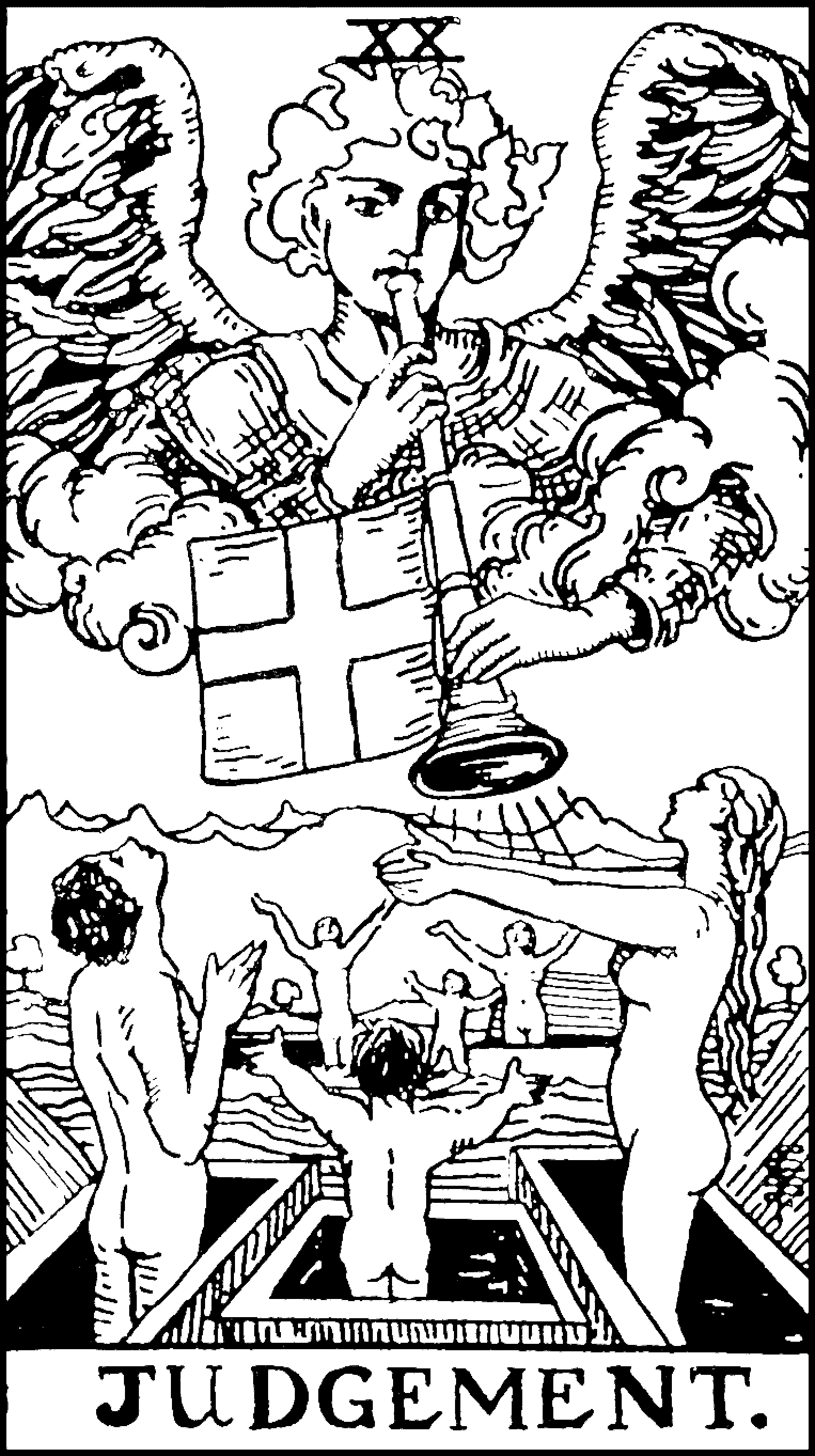
Judgement

13. Fellowship with Men
10. Treading [Conduct]
This week we have been thinking about fear. Our thoughts are not uncomplicated — we know fear, on the one hand, to be a positive honing device, that is, any talents we have, are made sharper by an awareness/attentiveness produced by sincere worry. But of course we also know the negative side of fear, that when excessive it can hold one back in a torpor of indecision. Further nuancing the matter, we understand that the human body/mind wants rhythm above all else — it would like things to be fearful or brave — it doesn’t have an easy time volleying between the two (this is one of the main reasons why we are ALL so cowardly — our psychological systems can’t take the barrage of the unknown for any length of time — so we ALL adopt a consistent public face — one that hides our continual private fear — (and then just rely on strength in numbers for a shared usually binaristic/polar view).
So, our query really isn’t about fear but how to be strong enough to be fearful when it is appropriate to be fearful and be brave when it is appropriate to be brave… Etc.
So, our query really isn’t about fear but how to be strong enough to be fearful when it is appropriate to be fearful and be brave when it is appropriate to be brave… Etc.
You must continually work to pry your clenched fingers from their wrapped grip on the past — this is one of fear’s great powers — knowing that no one wants to get hurt again in that way… But one lives in illusion if one believes difficulties and tragedy can wholly be prevented by preparation. Tragedy is always a surprise.
Also, do not worry in private, try to develop a system with your peers in which you can make mistakes openly. This requires that you involve yourself in continual communication. Without communication there is only confusion and confusion always leads to fear.
NEVER let suspicious or paranoid thoughts run their full course — do whatever you can to stop them in their tracks — they are the most corrosive and disgusting thing a human can produce.
Behave appropriately — that is consider your actions always — if anger, after personal deliberation, seems the most appropriate response to a given situation, then let it rip. But never be angry, mild, disaffected or analytical by whim alone. Strive for personal decorum at all times.
This week we pulled the Judgement card. The appearance of this card usually points to a time of personal reckoning — the opportunity for truly taking stock of what has transpired in one’s life, and using this evaluation to see what is likely to occur in the future. The future is mostly fixed but not wholly — assess and improve what you can.
Our first hexagram this week is #13, Fellowship with Men. Here we have a detailing of what creates a strong body of people, namely a particular type of individual — a person of a “yielding nature among many firm persons…” This is quite wonderful; it doesn’t say that a leader need be domineering and unwavering — but quite the opposite: yielding. It goes on to say more about the theme and style that unites as well: “true fellowship among people must be based upon a concern that is universal. It is not the private interests of the individual that create lasting fellowship among people, but rather the goals of humanity. That is why it is said that fellowship with people in the open succeeds. If unity of this kind prevails, even difficult and dangerous tasks… can be accomplished. But in order to bring about this sort of fellowship, a persevering and enlightened leader is needed—an individual with clear, convincing, and inspiring aims and the strength to carry them out.” There were two changes this week, of which the specific notes are: selfishness inevitably leads to humiliation and suspicion and paranoia should NEVER be allowed to run a course — they should be stopped as soon as possible (do you hear that people of the internet).
Our second hexagram, the one that suggests how best to meet the challenges (or the changes) is #10, Treading (Conduct). Here we have thoughts on social structures — the words of this hexagram venture a notion that is very tender in our era. What is said here should be read in a kind spirit of anti-utopian rationality, not as a declaration of any sort of rightist or leftist absolutism. The I Ching always focuses on a deeply loving realism to foster true amelioration of suffering. “Among humankind there are necessarily differences of elevation; it is impossible to bring about universal equality. But it is important that differences in social rank should not be arbitrary and unjust, for if this occurs, envy and class struggle are the inevitable consequences. If, on the other hand, external differences in rank correspond with differences in inner worth, and if inner worth forms the criterion of external rank, people acquiesce and order reigns in society.” But of course people are quite selfish and scared — it helps to have a way to interact “…In terms of a human situation, one is handling wild, intractable people. In such a case one’s purpose will be achieved if one behaves with decorum. Pleasant manners succeed even with irritable people.”