Jun 11 24
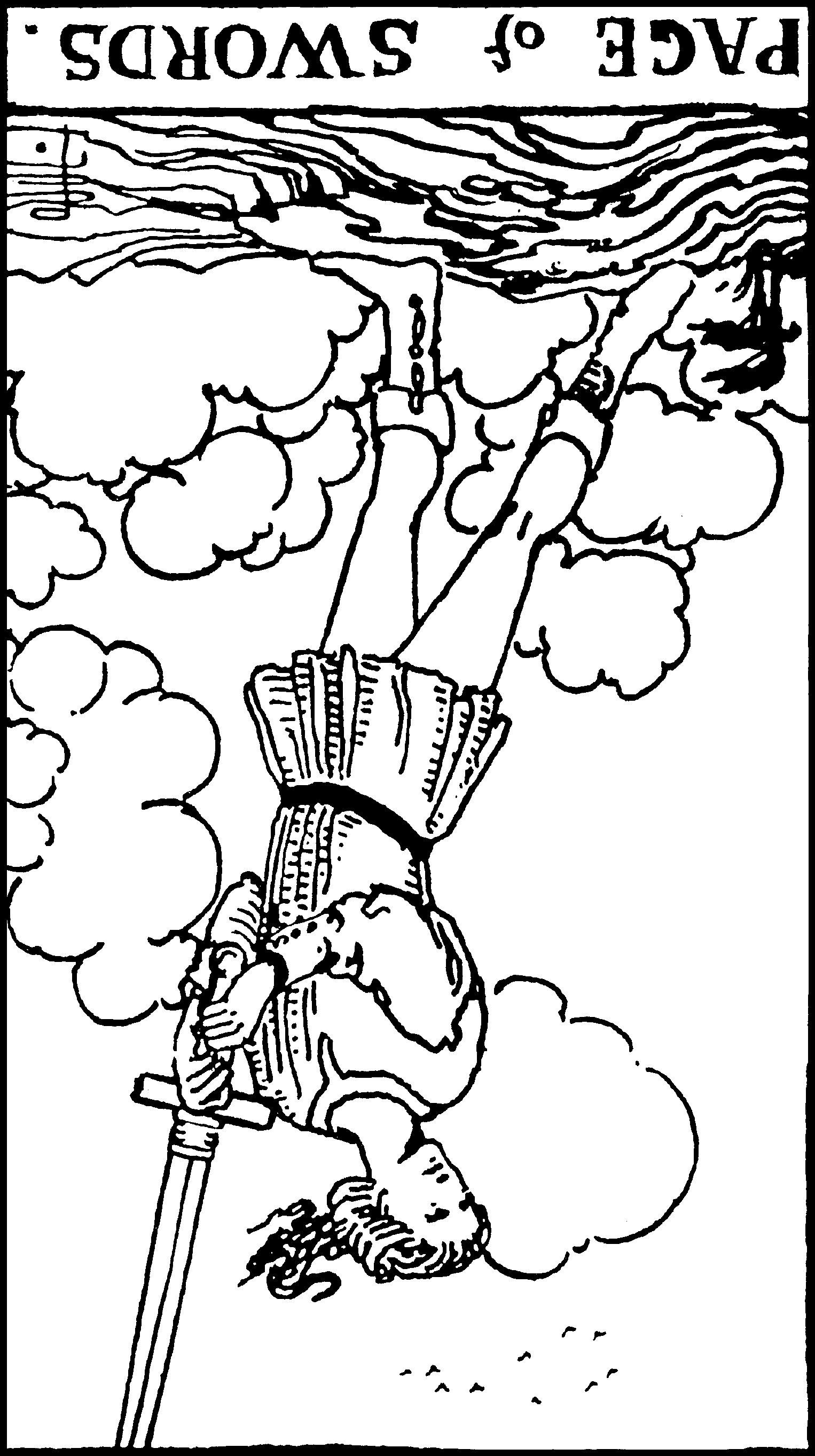
Page of Swords (reversed)

61. Inner Truth
22. Grace
These first few lines are the general aphoristic returns for the week. They are raw and uninterpreted; there to use how you’d like. (The specific readings follow.)
From “M.S.”: Keeping in mind that: “A” emotions are part of a larger system of mammalian survival, “B” emotions are pretty insubstantial (frustratingly vaporous) when looked at directly, and “C” emotions are always there like an, often, hyperbolic compass (whether we like it or not)... is it best to try to control emotions, or to express them, or... try not to think about them too much at all (like to go with the flow as it were)?
The emotions are a kind of internal weather — seemingly straightforward — but deeply complex. Weather can be lightly parsed into conditions like rain, snow, wind, etc. but this is a gross oversimplification. When one sincerely considers weather phenomena what is revealed is a complexity so deep that it is indistinguishable from the earth itself.
You are your emotions. Simplify them or disregard them or disrespect them at your peril. It is a life’s work to nurture and be in accord with your emotions.
Complete Reading
This week we pulled the Page of Swords (reversed). When upright the card indicates an alertness as pertains to investigating and vigilant analysis — however when reversed as it is here the behavior is more towards paranoia or over-scrutiny of a data or a situation.
Our first hexagram this week is #61, Inner Truth. Powerful communities can only develop “when the bond is based on what is right, on steadfastness.” As well, it is intimated that understanding what is “right” is based on deep “sympathy” and “understanding” — not caused by being exclusive or intimate. There must be perseverance/constancy in what is common. Intimacy is the most important tool for creating improvements (or change), think powerful vulnerability! Or more simply Love.
There were three changes this week of which the notes are: “whenever a feeling is voiced with truth and frankness, whenever a deed is the clear expression of sentiment, a mysterious and far-reaching influence is exerted” and if your inner peace and happiness relies on other people you will be perpetually tossed about like a leaf in the wind.
Our second hexagram, the one that suggests how best to meet the challenges (or the changes) is 22, Grace. Here, a rather specific admonition regarding beauty (“grace”) defined as: “beauty of form.” Though it states that the “beauty of form — is necessary in any union if it is to be well ordered and pleasing rather than disordered and chaotic” it adds that beauty/grace “is not the essential or fundamental thing; it is only the ornament and therefore to be used sparingly, in little things.” Ultimately saying “by contemplating the forms existing in the heavens we come to understand time and its changing demands. Through contemplation of the forms existing in human society it becomes possible to shape the world.” The sum point seems to be this: valuing beauty is fundamental in all endeavors, but thinking beauty to be the main or only thing to consider, can lead to catastrophe — a beautiful surface can mislead if other depth examinations aren’t appraised.
- Be careful that curiosity doesn’t turn into paranoia or something like conspiracy anxiety.
- Understanding what is “right” is based on deep “sympathy.”
- Intimacy and vulnerability are the most powerful tools for creating improvements (or change). “Truth and frankness.”
- “Whenever a feeling is voiced with truth and frankness, whenever a deed is the clear expression of sentiment, a mysterious and far-reaching influence is exerted.”
- If your inner peace and happiness relies on other people you will be perpetually tossed about like a leaf in the wind.
- Never rely on surface beauty to understand hidden structure.
- Emotions are the weather of one’s head.
From “M.S.”: Keeping in mind that: “A” emotions are part of a larger system of mammalian survival, “B” emotions are pretty insubstantial (frustratingly vaporous) when looked at directly, and “C” emotions are always there like an, often, hyperbolic compass (whether we like it or not)... is it best to try to control emotions, or to express them, or... try not to think about them too much at all (like to go with the flow as it were)?
The emotions are a kind of internal weather — seemingly straightforward — but deeply complex. Weather can be lightly parsed into conditions like rain, snow, wind, etc. but this is a gross oversimplification. When one sincerely considers weather phenomena what is revealed is a complexity so deep that it is indistinguishable from the earth itself.
You are your emotions. Simplify them or disregard them or disrespect them at your peril. It is a life’s work to nurture and be in accord with your emotions.
Complete Reading
This week we pulled the Page of Swords (reversed). When upright the card indicates an alertness as pertains to investigating and vigilant analysis — however when reversed as it is here the behavior is more towards paranoia or over-scrutiny of a data or a situation.
Our first hexagram this week is #61, Inner Truth. Powerful communities can only develop “when the bond is based on what is right, on steadfastness.” As well, it is intimated that understanding what is “right” is based on deep “sympathy” and “understanding” — not caused by being exclusive or intimate. There must be perseverance/constancy in what is common. Intimacy is the most important tool for creating improvements (or change), think powerful vulnerability! Or more simply Love.
There were three changes this week of which the notes are: “whenever a feeling is voiced with truth and frankness, whenever a deed is the clear expression of sentiment, a mysterious and far-reaching influence is exerted” and if your inner peace and happiness relies on other people you will be perpetually tossed about like a leaf in the wind.
Our second hexagram, the one that suggests how best to meet the challenges (or the changes) is 22, Grace. Here, a rather specific admonition regarding beauty (“grace”) defined as: “beauty of form.” Though it states that the “beauty of form — is necessary in any union if it is to be well ordered and pleasing rather than disordered and chaotic” it adds that beauty/grace “is not the essential or fundamental thing; it is only the ornament and therefore to be used sparingly, in little things.” Ultimately saying “by contemplating the forms existing in the heavens we come to understand time and its changing demands. Through contemplation of the forms existing in human society it becomes possible to shape the world.” The sum point seems to be this: valuing beauty is fundamental in all endeavors, but thinking beauty to be the main or only thing to consider, can lead to catastrophe — a beautiful surface can mislead if other depth examinations aren’t appraised.