Nov 23 21
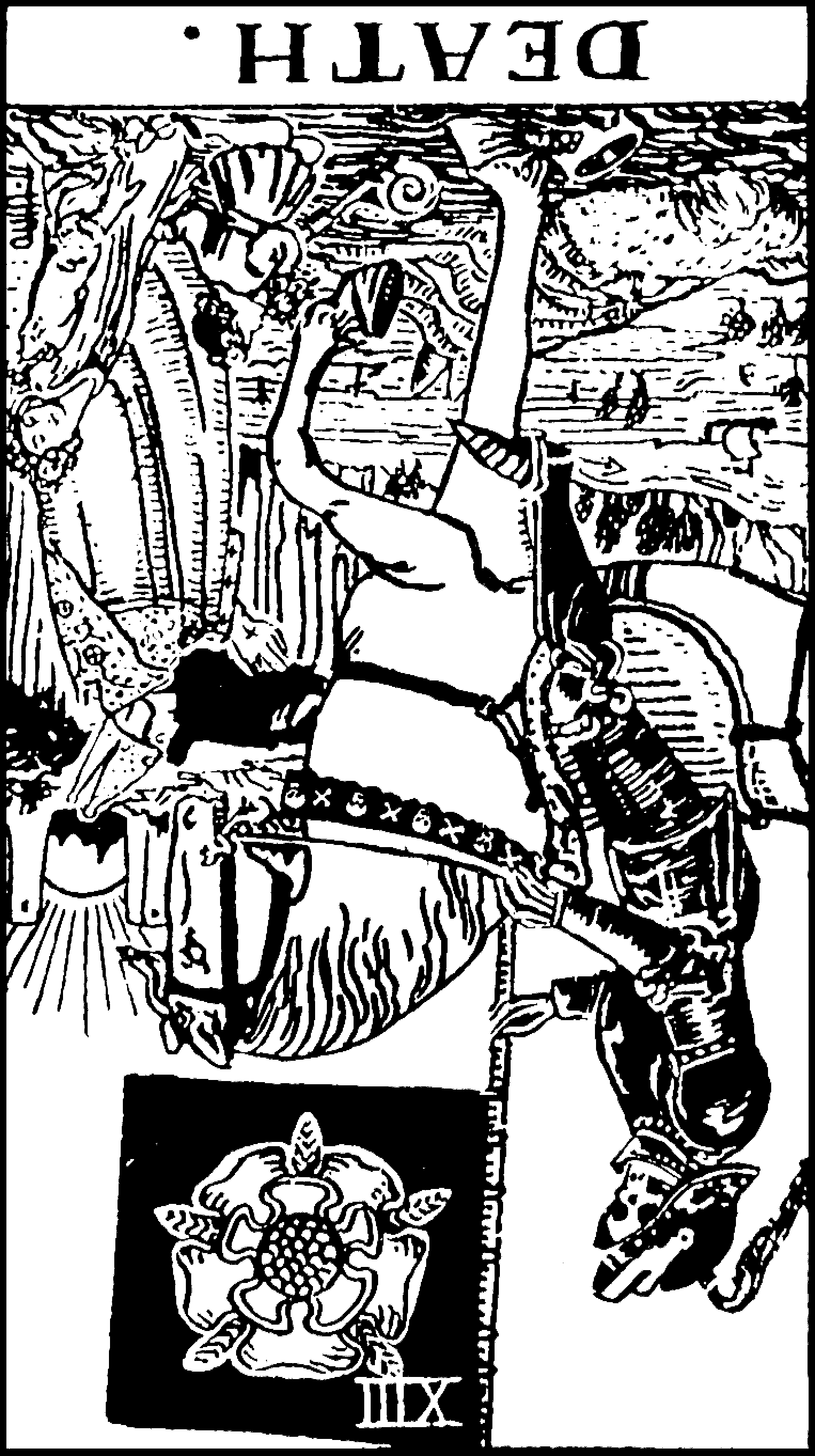
Death (reversed)

20. Contemplation (View)
6. Conflict
Petite Reading
Creation is both a gorgeous and a very painful process (to paraphrase Pedro Almodóvar). Sincere creation requires one to be variously patient, aggressive, cajoling, genuine, focussed, dismissive, reflective, expressive and a few many other modes. Ultimately it could be said that creation is conflict. If you are moved to create you are going to have to be absolutely inflexible in your pursuit of your ideal whilst being highly accepting of change; this is the conundrum of creative peoples. If you like us are creative, we say congratulations and we are so very sorry.
Complete Reading
This week we pulled the Death card, reversed. Death is probably the most immediately disturbing card in the tarot deck — which in and of itself speaks to its key meaning: change. Most of us fear death, as it is perceived as the ultimate “change.” A fear of change makes sense for us humans as establishing stability is very important. But living things always overdo it. Stability is somewhat possible but absolute security is not. A belief in absolute security makes the experience of change deeply frightening. When the Death card arrives in a reversed position it indicates that there is an inordinate resistance to change. Since everything is ALWAYS changing (even real time revolutions are subject to independent flux 🤔) relinquishing oneself to mutation and evolution is a mandatory skill.
Our first hexagram this week is #20, Contemplation (View). In the first part of the hexagram’s description there is a deep and beautiful exposition of something like how to live by example. “A slight variation of tonal stress gives the Chinese name for this hexagram a double meaning. It means both contemplating and being seen, in the sense of being an example. These ideas are suggested by the fact that the hexagram can be understood as picturing a type of tower characteristic of ancient China… A tower of this kind commanded a wide view of the country; at the same time, when situated on a mountain, it became a landmark that could be seen for miles around.” So it suggested, that if you have a broad, encompassing outlook make sure it is seen by many people, as an ideal of conduct. There were two changes this week, of which the specific notes are: “contemplation is subjectively limited” and promote those that have true vision.
Our second hexagram, the one that suggests how best to meet the challenges (or the changes) is # 6, Conflict. Conflict is inevitable in life — topographies (both literally and symbolically) are simply too wide ranging for guaranteed fluidity. For enterprises “to be successful they require concerted unity of forces” therefore it is unwise to proceed any further with an endeavor without respect and a mutuality of knowledge. If there is no dignity at the beginning of a collaboration do not proceed.
Creation is both a gorgeous and a very painful process (to paraphrase Pedro Almodóvar). Sincere creation requires one to be variously patient, aggressive, cajoling, genuine, focussed, dismissive, reflective, expressive and a few many other modes. Ultimately it could be said that creation is conflict. If you are moved to create you are going to have to be absolutely inflexible in your pursuit of your ideal whilst being highly accepting of change; this is the conundrum of creative peoples. If you like us are creative, we say congratulations and we are so very sorry.
Complete Reading
This week we pulled the Death card, reversed. Death is probably the most immediately disturbing card in the tarot deck — which in and of itself speaks to its key meaning: change. Most of us fear death, as it is perceived as the ultimate “change.” A fear of change makes sense for us humans as establishing stability is very important. But living things always overdo it. Stability is somewhat possible but absolute security is not. A belief in absolute security makes the experience of change deeply frightening. When the Death card arrives in a reversed position it indicates that there is an inordinate resistance to change. Since everything is ALWAYS changing (even real time revolutions are subject to independent flux 🤔) relinquishing oneself to mutation and evolution is a mandatory skill.
Our first hexagram this week is #20, Contemplation (View). In the first part of the hexagram’s description there is a deep and beautiful exposition of something like how to live by example. “A slight variation of tonal stress gives the Chinese name for this hexagram a double meaning. It means both contemplating and being seen, in the sense of being an example. These ideas are suggested by the fact that the hexagram can be understood as picturing a type of tower characteristic of ancient China… A tower of this kind commanded a wide view of the country; at the same time, when situated on a mountain, it became a landmark that could be seen for miles around.” So it suggested, that if you have a broad, encompassing outlook make sure it is seen by many people, as an ideal of conduct. There were two changes this week, of which the specific notes are: “contemplation is subjectively limited” and promote those that have true vision.
Our second hexagram, the one that suggests how best to meet the challenges (or the changes) is # 6, Conflict. Conflict is inevitable in life — topographies (both literally and symbolically) are simply too wide ranging for guaranteed fluidity. For enterprises “to be successful they require concerted unity of forces” therefore it is unwise to proceed any further with an endeavor without respect and a mutuality of knowledge. If there is no dignity at the beginning of a collaboration do not proceed.