Jan 30 24
The Hermit

28. Preponderance of the Great
43. Break-through (Resoluteness)
These first few lines are the general aphoristic returns for the week. They are raw and uninterpreted; there to use how you’d like. (The specific readings follow.)
From “M.S.”: It seems that the strongest motivators by far are joy/attraction and fear/revulsion. We have entered a period in which the personal causes of these opposing agents are very clear to us — thus we have a growing and sincere desire to do whatever we can to pursue that which gives us joy [in our case art and design (both creating and consuming)] — and do our best to set aside our revulsion and fears. But this is quite difficult as there are many hindrances — chief amongst them, an era of peers transcendentally complicit in and defined by the corporate dismantling of individuality (that is, the eroding of the biodiversity of ideas, the “silent spring” of the mind) and the fostering of the belief that beauty can be experienced without tension and ambiguity... and general/typical personal responsibilities. Any advice?
If you have strong revulsions and attractions, and can successfully apply them to design and art, you are lucky. Keep at it and don’t hide the results — share, shape and publish. In religious contexts the situation is often referred to as a calling.
You will face a lot of derision following your own path — especially if it’s out in the open. But be resolute; if you, for the most part, know what you love you can forestall against tragedy by constantly asking how to preserve and protect it.
Be an aspirant and someone to aspire to.
Complete Reading
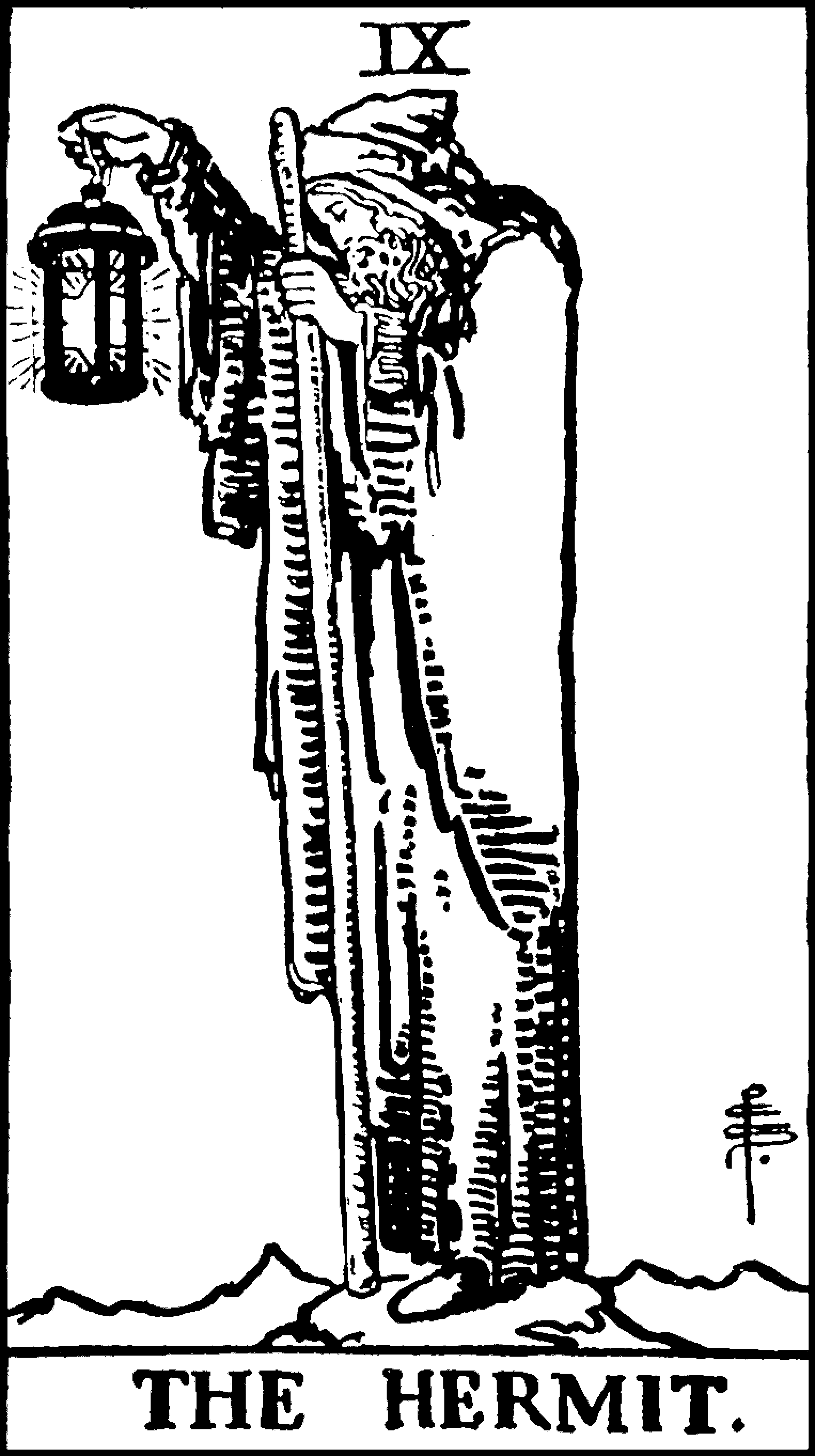
This week we pulled the Hermit. Most interpretations of this card are as expected: occult isolation, inward exploration, etc.. However, we have alighted on a meaning based on a connection we see between the Smith/Waite hermit (which is the tarot version we utilize) and the 20th hexagram of the I Ching: Kuan (Contemplation). The symbolism of the 20th hexagram is two-fold, a lay person contemplating a holy person as seen in a tower, and the actual contemplation (and high, mystical view) of the holy person themself. In the chapter on “The Hermit” in his Pictorial Key to the Tarot Waite actively eschews the idea that a hermit is only a recondite mystic — emphasizing that the hermit is high on a cliff thus clearly visible and rather than being partially hidden by his vestments, the hermit’s lamp/star blazes openly, un-obscured. Waite sums up the hermit’s image as a deep invitation: “where I am you may also be.”
Our first hexagram this week is #28, Preponderance of the Great. The image here is of a horizontal support that is too weak, in its center, to hold the weight of a ceiling. It is suggested that though the situation is dire, the centeredness makes the problem easily identifiable — thus a solution is not hidden or hard to figure, and can be addressed in time. The hexagram also bears the symbolism of a strong person who, because of inner joy and resoluteness, can bear difficult times, knowing that they are temporary.
There was one change this week, of which the specific note is: in times of great change or great dynamism, introducing a significant offering (a business, a product, a relationship) takes much caution, planning/preparation and responsible follow-through.
Our second hexagram, the one that suggests how best to meet the challenges (or the changes) is #43, Break-through (Resoluteness). To win out over those full of guile and selfishness — those totally barren of the decency of compromise — one must be absolutely steadfast in the belief in the decency of compromise (a truly multi-perspective view). To fight/reorient decency bereft types one cannot match their opponents violent methods or else they risk being lost in a horrible over-focus of their own. One must commit to calling out exterior as well as personal injustice. It is said here that “the best way to fight evil is to make energetic progress in the good.” People often bristle at “the good” of that sentence, like “what could possibly be said to be universally good?” There is an answer: Try to do good, always. TRY to be honest, TRY to pause before acting rashly. No, there is no universal good except that of TRYING TO DO GOOD.
- Seriously consider the mystic viewpoint.
- Be a visual manifestation (a public example) of your loves and trials.
- There is no universal good except trying to do good.
- All things are temporary whether difficult or easy — so stay committed to your joys — as not to get lost in the changes, the endless novelties/topicalities.
- In turbulent times extra care is needed when introducing a new project.
From “M.S.”: It seems that the strongest motivators by far are joy/attraction and fear/revulsion. We have entered a period in which the personal causes of these opposing agents are very clear to us — thus we have a growing and sincere desire to do whatever we can to pursue that which gives us joy [in our case art and design (both creating and consuming)] — and do our best to set aside our revulsion and fears. But this is quite difficult as there are many hindrances — chief amongst them, an era of peers transcendentally complicit in and defined by the corporate dismantling of individuality (that is, the eroding of the biodiversity of ideas, the “silent spring” of the mind) and the fostering of the belief that beauty can be experienced without tension and ambiguity... and general/typical personal responsibilities. Any advice?
If you have strong revulsions and attractions, and can successfully apply them to design and art, you are lucky. Keep at it and don’t hide the results — share, shape and publish. In religious contexts the situation is often referred to as a calling.
You will face a lot of derision following your own path — especially if it’s out in the open. But be resolute; if you, for the most part, know what you love you can forestall against tragedy by constantly asking how to preserve and protect it.
Be an aspirant and someone to aspire to.
Complete Reading
This week we pulled the Hermit. Most interpretations of this card are as expected: occult isolation, inward exploration, etc.. However, we have alighted on a meaning based on a connection we see between the Smith/Waite hermit (which is the tarot version we utilize) and the 20th hexagram of the I Ching: Kuan (Contemplation). The symbolism of the 20th hexagram is two-fold, a lay person contemplating a holy person as seen in a tower, and the actual contemplation (and high, mystical view) of the holy person themself. In the chapter on “The Hermit” in his Pictorial Key to the Tarot Waite actively eschews the idea that a hermit is only a recondite mystic — emphasizing that the hermit is high on a cliff thus clearly visible and rather than being partially hidden by his vestments, the hermit’s lamp/star blazes openly, un-obscured. Waite sums up the hermit’s image as a deep invitation: “where I am you may also be.”
Our first hexagram this week is #28, Preponderance of the Great. The image here is of a horizontal support that is too weak, in its center, to hold the weight of a ceiling. It is suggested that though the situation is dire, the centeredness makes the problem easily identifiable — thus a solution is not hidden or hard to figure, and can be addressed in time. The hexagram also bears the symbolism of a strong person who, because of inner joy and resoluteness, can bear difficult times, knowing that they are temporary.
There was one change this week, of which the specific note is: in times of great change or great dynamism, introducing a significant offering (a business, a product, a relationship) takes much caution, planning/preparation and responsible follow-through.
Our second hexagram, the one that suggests how best to meet the challenges (or the changes) is #43, Break-through (Resoluteness). To win out over those full of guile and selfishness — those totally barren of the decency of compromise — one must be absolutely steadfast in the belief in the decency of compromise (a truly multi-perspective view). To fight/reorient decency bereft types one cannot match their opponents violent methods or else they risk being lost in a horrible over-focus of their own. One must commit to calling out exterior as well as personal injustice. It is said here that “the best way to fight evil is to make energetic progress in the good.” People often bristle at “the good” of that sentence, like “what could possibly be said to be universally good?” There is an answer: Try to do good, always. TRY to be honest, TRY to pause before acting rashly. No, there is no universal good except that of TRYING TO DO GOOD.