Jun 09 26
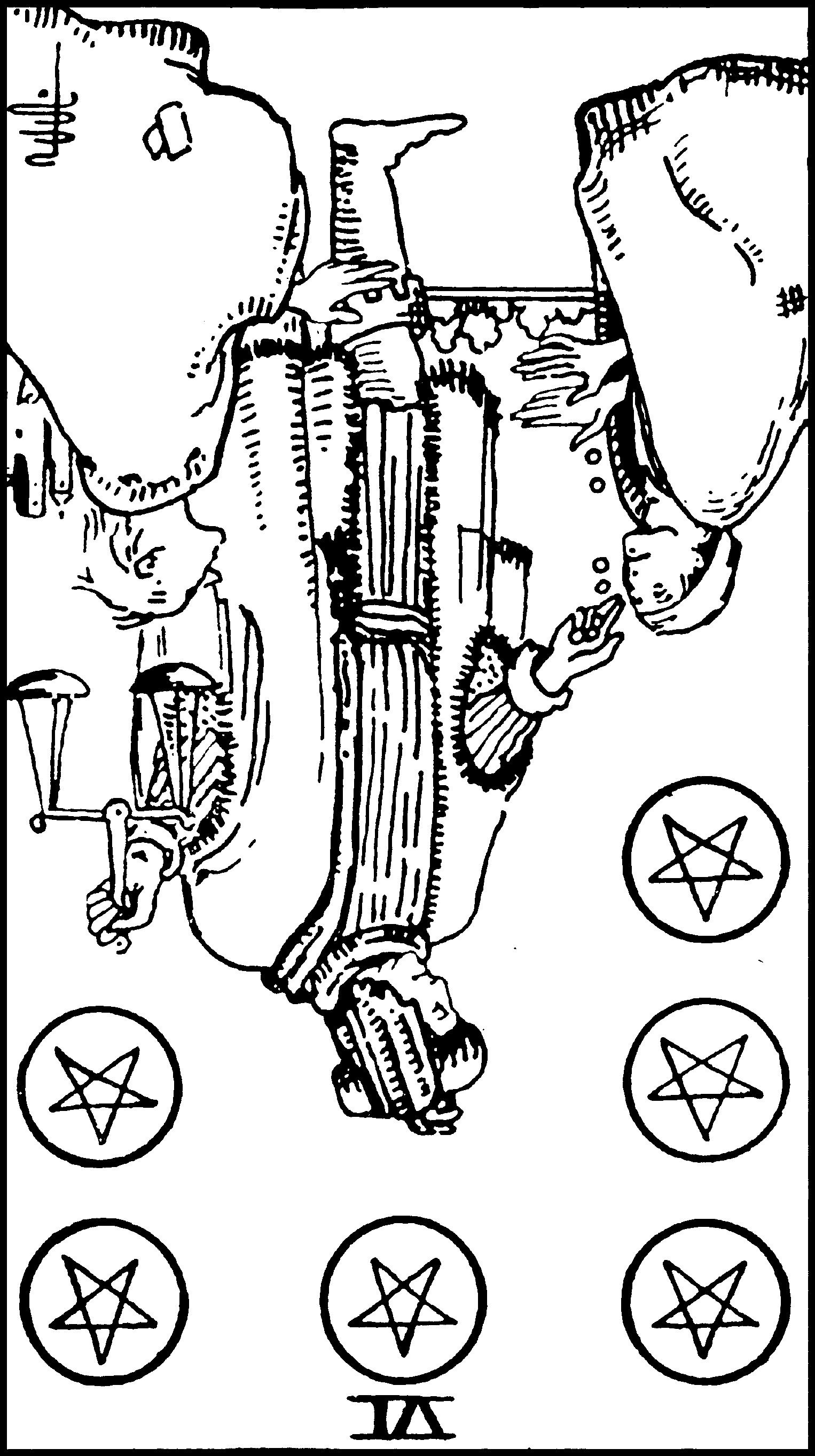
Six of Pentacles (reversed)

35. Progress
21. Biting Through
21. Biting Through
These first few lines are the general aphoristic returns for the week. They are raw and uninterpreted; there to use how you’d like. (The specific readings follow.)
Question from “R.B.”: Something proposed is completely different from the realization of a proposal. A proposition is, more often than not, an endorphin rich mode — intoxicating, because it is full of possibilities (absent of actualities). Propositions live in direct contrast to the drudgery of integrating and maintaining a fixed idea into full-dimensional randomness of the world situation. Ultimately, a proposal doesn’t like to see itself as a transmogrification process, that of turning an unfixed idea into a fixed idea. Thus, to us, proposals seem like a ruse, a glamorous front that actively conceals its eventual hierarchy (that will likely only be very fun and enriching for a very few people — which is often quite similar to the old rejected situation). The I Ching (“no haste, no rest,” etc.) seems a perfect place to address such conundrums. What is the best style of governance that strives for deep/wide dignity, whilst not falling prey to transcendentally seductive open propositions?
Oracle reply: ALL (not some) governance will tend toward sadistic control. The wisdom, or perspective, needed for leaders to overcome this tendency, will come from extrication from the overtly specific (the excessively earthbound) realms; that is, to find a wider/higher view. Long term dignity for the greatest number of people, can’t be bogged down by the transcendentally empirical or the absurdly particularist. As well, the methods to administer this (laws) should always strive to eliminate any drama. Governance should not feel like theatre, but a movement of order as natural as the movements of storms, sand dunes and seasons — an impartial but hallowed naturalness (again, dignity).
Complete Reading:
This week we pulled Six of Pentacles (reversed). When upright, the meaning is something like stable sharing; the moment stability blossoms/matures into participation with the world. When reversed, as it is here, abundance takes the darker path to miserliness and, sometimes, even to sadism — the illusion that there can ever be control.
Our first hexagram this week is #35, Progress. Like the sun emerging from the earth’s constant turn from darkness, a human must turn away and rise above purely earthbound concerns, so as to have the most light and clarity.
There was one change this week of which the note is: When the dominant mode is emergence (that is, a time not within the momentum of establishment) don’t get prematurely caught up in alliances or dogmatics; remain open and cheerful.
Our second hexagram, the one that suggests how best to meet the challenges (or the changes) is #21, Biting Through. Rules/laws are necessary and innate to human life. Breaking of rules is also innate (not necessarily pervasive, but innate). When this happens there must be penalties. However the penalties should be “certain and swift” — not drawn out or executed with drama, but with the dignity of wave or wind.
- Be careful! Stability through abundance often sours to fearful, miserly sadism.
- Control is an illusion; vigilance is not.
- For clarity and light, humans must separate themselves from purely earthbound concerns.
- In a time of emergence don’t get prematurely caught up in alliances or dogmatics; remain open and cheerful.
- Since violations of laws are as natural as laws themselves — and the latter are absolutely necessary — punishment for infractions should be carried out swiftly and without drama, that is, with dignity.
Question from “R.B.”: Something proposed is completely different from the realization of a proposal. A proposition is, more often than not, an endorphin rich mode — intoxicating, because it is full of possibilities (absent of actualities). Propositions live in direct contrast to the drudgery of integrating and maintaining a fixed idea into full-dimensional randomness of the world situation. Ultimately, a proposal doesn’t like to see itself as a transmogrification process, that of turning an unfixed idea into a fixed idea. Thus, to us, proposals seem like a ruse, a glamorous front that actively conceals its eventual hierarchy (that will likely only be very fun and enriching for a very few people — which is often quite similar to the old rejected situation). The I Ching (“no haste, no rest,” etc.) seems a perfect place to address such conundrums. What is the best style of governance that strives for deep/wide dignity, whilst not falling prey to transcendentally seductive open propositions?
Oracle reply: ALL (not some) governance will tend toward sadistic control. The wisdom, or perspective, needed for leaders to overcome this tendency, will come from extrication from the overtly specific (the excessively earthbound) realms; that is, to find a wider/higher view. Long term dignity for the greatest number of people, can’t be bogged down by the transcendentally empirical or the absurdly particularist. As well, the methods to administer this (laws) should always strive to eliminate any drama. Governance should not feel like theatre, but a movement of order as natural as the movements of storms, sand dunes and seasons — an impartial but hallowed naturalness (again, dignity).
Complete Reading:
This week we pulled Six of Pentacles (reversed). When upright, the meaning is something like stable sharing; the moment stability blossoms/matures into participation with the world. When reversed, as it is here, abundance takes the darker path to miserliness and, sometimes, even to sadism — the illusion that there can ever be control.
Our first hexagram this week is #35, Progress. Like the sun emerging from the earth’s constant turn from darkness, a human must turn away and rise above purely earthbound concerns, so as to have the most light and clarity.
There was one change this week of which the note is: When the dominant mode is emergence (that is, a time not within the momentum of establishment) don’t get prematurely caught up in alliances or dogmatics; remain open and cheerful.
Our second hexagram, the one that suggests how best to meet the challenges (or the changes) is #21, Biting Through. Rules/laws are necessary and innate to human life. Breaking of rules is also innate (not necessarily pervasive, but innate). When this happens there must be penalties. However the penalties should be “certain and swift” — not drawn out or executed with drama, but with the dignity of wave or wind.