May 05 26
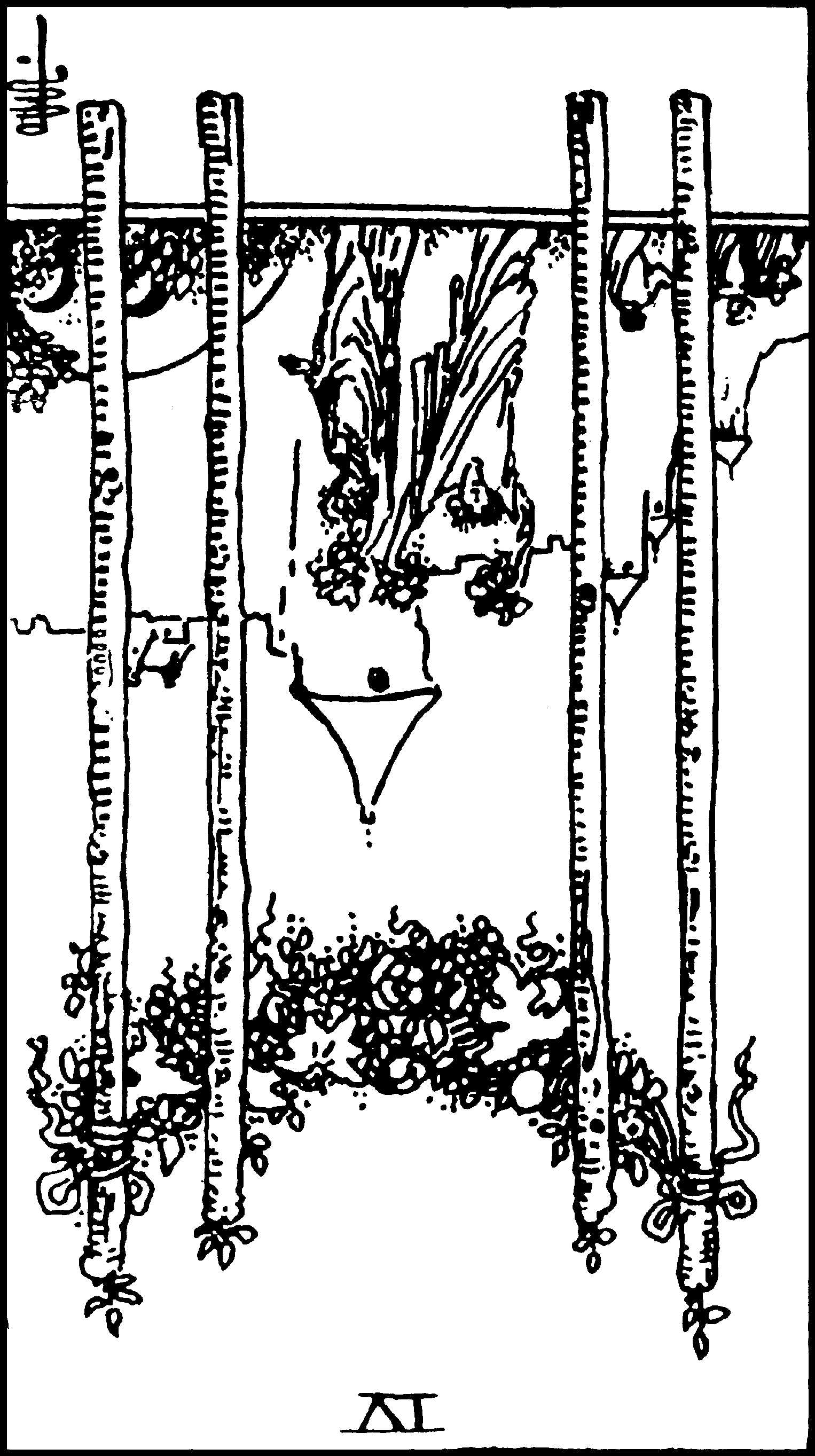
Four of Wands (reversed)

4. Youthful Folly
36. Darkening of the Light
36. Darkening of the Light
These first few lines are the general aphoristic returns for the week. They are raw and uninterpreted; there to use how you’d like. (The specific readings follow.)
Question from “B.L.”: Because of humanity’s transcendentally faulty perceptive mechanisms, and the infinitely faceted, infinitely morphing world it finds itself in (or is caused by or however that can possibly be phrased) I find it impossible to believe in any of the predictive, overarching, scientific, religious, cultural, or political ideologies — and I find it beyond odd that anyone does (except maybe for general, involuntary evolutionary/adaptive reasons).
But I am not an anarchist or a (complete) pessimist — and though I am a pretty serious misanthrope (which doesn’t exclude hatred of the self) I am still open to thoughts of improvement, innovation, and management. I guess, ultimately, I am anti-solution and anti-promises, that is, I despise ANYONE who says they know how things are going to play out or how to fix things (and I despise their dark methods of getting people addicted to their empty promises and their disgusting/putrid distraction methods) whether this occurs person to person, group to person or group to group.
What can an existing and underway system do to manage (not solve) the insoluble differences between people and their immovably faulty impressions (and subsequent beliefs) and strivingly pursue good standing, with sanitation, medicine, disaster preparedness, reasonable education, electricity, etc., etc.?
Oracle reply: It is too wide a question but there is an answer:
Complete Reading:
This week we pulled Four of Wands (reversed). This is a card of foundational solidity — an implication of accord with the varied aspects of a full life. However, when reversed as it is here, community, family, production, celebration, are being disrupted. General accord is not to be found nor are the sense of beauty and the sense of enjoyment.
Our first hexagram this week is #4, Youthful Folly. Youth learns in error and is thus blameless. But how the young learn is of utmost importance (there are a lot of terrible adults after all) — they must have the right teacher, the right relation to the teacher, and they can skip no steps. This is that adage: the student seeks the teacher, not the other way around (“the teacher must wait to be sought out instead of offering themself. Only thus can the instruction take place at the right time and in the right way”). As well, “a spring succeeds in flowing on and escapes stagnation by filling up all the hollow places in its path. In the same way character is developed by thoroughness that skips nothing but, like water, gradually and steadily fills up all gaps and so flows onward.”
There were four changes this week, of which the specific notes are:
Our second hexagram, the one that suggests how best to meet the challenges (or the changes) is #36, Darkening of the Light. Most of the time, positivity and light are to be encouraged — when encountering dark times or people — but this is not always the case. In certain periods of darkness “it is essential to be cautious and reserved. One should not needlessly awaken overwhelming enmity by inconsiderate behavior. In such times one ought not to fall in with the practices of others; neither should one drag them censoriously into the light. In social intercourse one should not try to be all–knowing. One should let many things pass, without being duped. So, in this interim period, don’t reveal, or introduce, rather, bide your time whilst being “outwardly yielding and tractable.” Also, “perseverance must dwell in inmost consciousness and should not be discernible from without.”
- You cannot imitate “success” to get it.
- “One should let many things pass, without being duped.”
- “The teacher must wait to be sought out instead of offering themself. Only thus can the instruction take place at the right time and in the right way.”
- Law and discipline are the beginning of education, but only if it doesn’t devolve into mindless drilling from the educator — it must be ever opening.
- Only toleration and kindliness towards human folly.
- Only the combination of inner strength with outer reserve enables one to take on the responsibility of directing a larger social body with real success.
- Punishment is necessary, but should never be executed with anger. “Punishment is never an end in itself but serves merely to restore order.”
Question from “B.L.”: Because of humanity’s transcendentally faulty perceptive mechanisms, and the infinitely faceted, infinitely morphing world it finds itself in (or is caused by or however that can possibly be phrased) I find it impossible to believe in any of the predictive, overarching, scientific, religious, cultural, or political ideologies — and I find it beyond odd that anyone does (except maybe for general, involuntary evolutionary/adaptive reasons).
But I am not an anarchist or a (complete) pessimist — and though I am a pretty serious misanthrope (which doesn’t exclude hatred of the self) I am still open to thoughts of improvement, innovation, and management. I guess, ultimately, I am anti-solution and anti-promises, that is, I despise ANYONE who says they know how things are going to play out or how to fix things (and I despise their dark methods of getting people addicted to their empty promises and their disgusting/putrid distraction methods) whether this occurs person to person, group to person or group to group.
What can an existing and underway system do to manage (not solve) the insoluble differences between people and their immovably faulty impressions (and subsequent beliefs) and strivingly pursue good standing, with sanitation, medicine, disaster preparedness, reasonable education, electricity, etc., etc.?
Oracle reply: It is too wide a question but there is an answer:
- Accord first, beauty and enjoyment after.
- Absolute commitment to continual wide, open education (real education, not propaganda, is a hill to die on).
- Order (and punishment) is necessary but should never be applied in anger but evenly, calmly and firmly.
- Inner strength of the individual for the outer strength of the group.
Complete Reading:
This week we pulled Four of Wands (reversed). This is a card of foundational solidity — an implication of accord with the varied aspects of a full life. However, when reversed as it is here, community, family, production, celebration, are being disrupted. General accord is not to be found nor are the sense of beauty and the sense of enjoyment.
Our first hexagram this week is #4, Youthful Folly. Youth learns in error and is thus blameless. But how the young learn is of utmost importance (there are a lot of terrible adults after all) — they must have the right teacher, the right relation to the teacher, and they can skip no steps. This is that adage: the student seeks the teacher, not the other way around (“the teacher must wait to be sought out instead of offering themself. Only thus can the instruction take place at the right time and in the right way”). As well, “a spring succeeds in flowing on and escapes stagnation by filling up all the hollow places in its path. In the same way character is developed by thoroughness that skips nothing but, like water, gradually and steadily fills up all gaps and so flows onward.”
There were four changes this week, of which the specific notes are:
- “Law is the beginning of education.” “He who plays with life never amounts to anything. However, discipline should not degenerate into drill. Continuous drill has a humiliating effect and cripples a man’s powers.”
- “The strength of mind to bear the burden of responsibility, the inner strength to enable toleration and kindliness towards the shortcomings of human folly. Only this combination of inner strength with outer reserve enables one to take on the responsibility of directing a larger social body with real success.”
- You can not imitate success to get it.
- Punishment is necessary but should never be executed with anger. “Punishment is never an end in itself but serves merely to restore order.”
Our second hexagram, the one that suggests how best to meet the challenges (or the changes) is #36, Darkening of the Light. Most of the time, positivity and light are to be encouraged — when encountering dark times or people — but this is not always the case. In certain periods of darkness “it is essential to be cautious and reserved. One should not needlessly awaken overwhelming enmity by inconsiderate behavior. In such times one ought not to fall in with the practices of others; neither should one drag them censoriously into the light. In social intercourse one should not try to be all–knowing. One should let many things pass, without being duped. So, in this interim period, don’t reveal, or introduce, rather, bide your time whilst being “outwardly yielding and tractable.” Also, “perseverance must dwell in inmost consciousness and should not be discernible from without.”