Feb 24 26
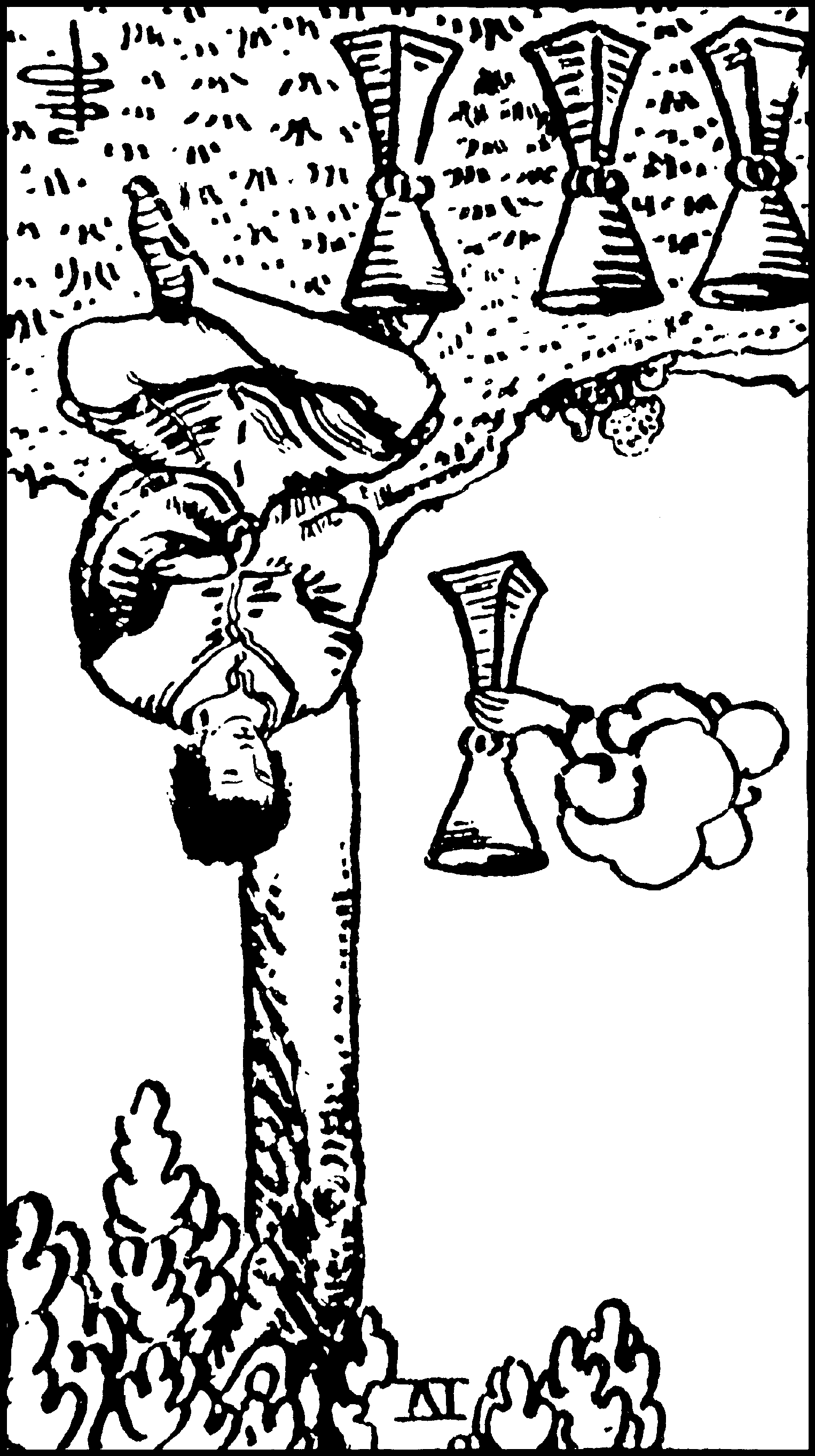
Four of Cups (reversed)

23. Splitting Apart
4. Youthful Folly
4. Youthful Folly
These first few lines are the general aphoristic returns for the week. They are raw and uninterpreted; there to use how you’d like. (The specific readings follow.)
Question from “N.H.L.”: Often, when I am vulnerable with people (in a serious, collaborative way - in a professional context) they meet the trusting openness as an opportunity to take petty dominance. Any advice for showing them that the goal of mutual unguarded trust is a FUNDAMENTAL element in, middle to long term, strength and growth; that there is no other way to nutritive collaboration?
Oracle reply: Though you are right that openness is fundamental for true collaborative progress (the I Ching’s modesty of student), you must understand that you cannot make people see what they are not ready to see, or even may never be able to see. The only path is transcendental patience. But this isn’t some inactive passivity, on the contrary, patience is the active essence of all that is “good” (emotional depth, the desire for universal dignity, multi-cameral/dimensional education, anti-hubris, anti-narcissism, good faith, strength within opposition).
A synonym for patience might be faith (optimistic belief). Faith need not be religious (it is not for us) — optimism is not cynicism — optimism can still manage difficult emotions like fear and worry, but it won’t tolerate cynicism (which is the most anti-creative, anti-curious, false transcendentally signified center, wholly narcissistic, mode).
Complete Reading:
This week we pulled the Four of Cups (reversed). When upright, the card indicates a kind weary dissatisfaction; one born of an abundance misread. When reversed, as it is here, the indication is that there’s an opportunity for a new way of doing/thinking — a kind of clarity in contrast to old habits. There is though, with this kind of heady/internal volleying, a further taxing of one’s emotions. If a too grand stance is sought again, further depression may result.
Our first hexagram this week is #23, Splitting Apart. “This pictures a time when inferior people are pushing forward and are about to crowd out the few remaining strong and superior people. Under these circumstances, which are due to the time, it is not favorable for superior people to undertake anything.” The tone here is that certain bad times are unavoidable; when darkness truly can’t be helped, it is recommended to remain quiet and inwardly devotional to all that brings peace and dignity. To wait for a time of action. In general, that is, experiencing the regularity of unavoidably bad times, one can make preparations — it is wise to be one who doesn’t act proud and narcissistic but lives for self and other’s dignity. Living like this lessens the severity of inevitable bad times, and promotes more dignity in the middle and long term.
There was one change this week of which the specific note is: “The power of the inferior people is growing... The danger draws close to one’s person — adjust to the time and promptly avoid the danger. Stubborn perseverance in maintaining one’s standpoint would lead to downfall.”
Our second hexagram, the one that suggests how best to meet the challenges (or the changes) is #4, Youthful Folly. “In the time of youth, folly is not an evil. One may succeed in spite of it, provided one finds an experienced teacher and has the right attitude toward them. This means, first of all, that the youth himself must be conscious of their lack of experience and must seek out the teacher... modesty and... interest... This is the reason why the teacher must wait to be sought out instead of offering themself. Only thus can the instruction take place at the right time and in the right way...” Here we have the origin (or at least a contender for the origin) of the aphorism: the student seeks the teacher, not the other way ‘round (or, “when the student is ready, the teacher appears”). Perhaps the essence of this notion is that the universal lesson of the teacher is patience [the endless persistence in time of the good (universal dignity, universal learning)]. If the teacher doesn’t embody this, perhaps they are not really a teacher.
- Clarity, in contrast to old habits, will bring new healthy alternatives and options.
- The student seeks the teacher, not the other way ‘round; as the teacher embodies universal patience (which is what the student needs to learn for all endeavors).
- Bad times are unavoidable; their survival requires transcendental patience. That is, waiting for the favorable time to act.
Question from “N.H.L.”: Often, when I am vulnerable with people (in a serious, collaborative way - in a professional context) they meet the trusting openness as an opportunity to take petty dominance. Any advice for showing them that the goal of mutual unguarded trust is a FUNDAMENTAL element in, middle to long term, strength and growth; that there is no other way to nutritive collaboration?
Oracle reply: Though you are right that openness is fundamental for true collaborative progress (the I Ching’s modesty of student), you must understand that you cannot make people see what they are not ready to see, or even may never be able to see. The only path is transcendental patience. But this isn’t some inactive passivity, on the contrary, patience is the active essence of all that is “good” (emotional depth, the desire for universal dignity, multi-cameral/dimensional education, anti-hubris, anti-narcissism, good faith, strength within opposition).
A synonym for patience might be faith (optimistic belief). Faith need not be religious (it is not for us) — optimism is not cynicism — optimism can still manage difficult emotions like fear and worry, but it won’t tolerate cynicism (which is the most anti-creative, anti-curious, false transcendentally signified center, wholly narcissistic, mode).
Complete Reading:
This week we pulled the Four of Cups (reversed). When upright, the card indicates a kind weary dissatisfaction; one born of an abundance misread. When reversed, as it is here, the indication is that there’s an opportunity for a new way of doing/thinking — a kind of clarity in contrast to old habits. There is though, with this kind of heady/internal volleying, a further taxing of one’s emotions. If a too grand stance is sought again, further depression may result.
Our first hexagram this week is #23, Splitting Apart. “This pictures a time when inferior people are pushing forward and are about to crowd out the few remaining strong and superior people. Under these circumstances, which are due to the time, it is not favorable for superior people to undertake anything.” The tone here is that certain bad times are unavoidable; when darkness truly can’t be helped, it is recommended to remain quiet and inwardly devotional to all that brings peace and dignity. To wait for a time of action. In general, that is, experiencing the regularity of unavoidably bad times, one can make preparations — it is wise to be one who doesn’t act proud and narcissistic but lives for self and other’s dignity. Living like this lessens the severity of inevitable bad times, and promotes more dignity in the middle and long term.
There was one change this week of which the specific note is: “The power of the inferior people is growing... The danger draws close to one’s person — adjust to the time and promptly avoid the danger. Stubborn perseverance in maintaining one’s standpoint would lead to downfall.”
Our second hexagram, the one that suggests how best to meet the challenges (or the changes) is #4, Youthful Folly. “In the time of youth, folly is not an evil. One may succeed in spite of it, provided one finds an experienced teacher and has the right attitude toward them. This means, first of all, that the youth himself must be conscious of their lack of experience and must seek out the teacher... modesty and... interest... This is the reason why the teacher must wait to be sought out instead of offering themself. Only thus can the instruction take place at the right time and in the right way...” Here we have the origin (or at least a contender for the origin) of the aphorism: the student seeks the teacher, not the other way ‘round (or, “when the student is ready, the teacher appears”). Perhaps the essence of this notion is that the universal lesson of the teacher is patience [the endless persistence in time of the good (universal dignity, universal learning)]. If the teacher doesn’t embody this, perhaps they are not really a teacher.