
50. The Cauldron
14. Possession in Great Measure
These first few lines are the general aphoristic returns for the week. They are raw and uninterpreted; there to use how you’d like. (The specific readings follow.)
Keep it simple stupid.
Time to retreat and strengthen.
No matter your position, persistent good will yields success.
“The rain will come in its own time. We cannot make it come; we have to wait for it.”
“Weakness and impatience can do nothing.”
Question from “X.L.R.”: It is our belief that human time is not an ultimate reality, that is, we are all really participants in like one endless, simultaneous, “day” (days themselves, simply being an over-demarcation of the continuous rotation of a spheroid moving fluidly in and out of a light source — a resultant, gradient shadow that we call “night” and the reverse “day” — with no real beginnings or endings). However, and nevertheless, this human time is a practical reality that we all involuntarily live in; one in which “time” has horizons, borders, tenses, ticks and tocks — a virtual, but necessary armature (like naming) employed for our survival.
Keeping this in mind what are the oracle’s thoughts on resolutions tied to (human/clock/calendar) time? Is it good to make goals of change or is it actually counterproductive — like a false reality that will ultimately only yield confusion and frustration?
Oracle reply: Though we are not at all religious, a close friend (who is more so) continually admonishes us that we are out of touch with our higher power. We always slightly, or severely, bristle at the (perceived) primitive silliness, like, where is this higher power, this invisible anthropomorphized spirit?
But always, we end up, after our frenzied periods of passionate denial, accepting that we are the foolish party, the unmoored skeptic — that this voice, this “higher power” is the simple (ultimately kind) voice of our own survival, a constant dulcet tone clouded by the noise of impatience, shame and frustration.
We all spend much of our time embroidering our self-doubt, and pushing past our calm to be part of distracting, short-term networks, neurotically detailing impossible general knowledges and pushing to participate in grotesque systems of reward and failure (both imposters as Crowley and others have noted). We ever outpace that voice that lets us know what our limits are. Our future self (which is the same as our “higher power”) with “alienated majesty” always says the same thing: keep it simple.
For those thicker of head: keep it simple stupid.
And directly from the I Ching: “Weakness and impatience can do nothing. Only a strong person can stand up to their fate, for their inner security enables them to endure to the end. This strength shows itself in uncompromising truthfulness [with themself]. It is only when we have the courage to face things exactly as they are, without any sort of self–deception or illusion, that a light will develop out of events, by which the path to success may be recognized.”
Complete Reading:
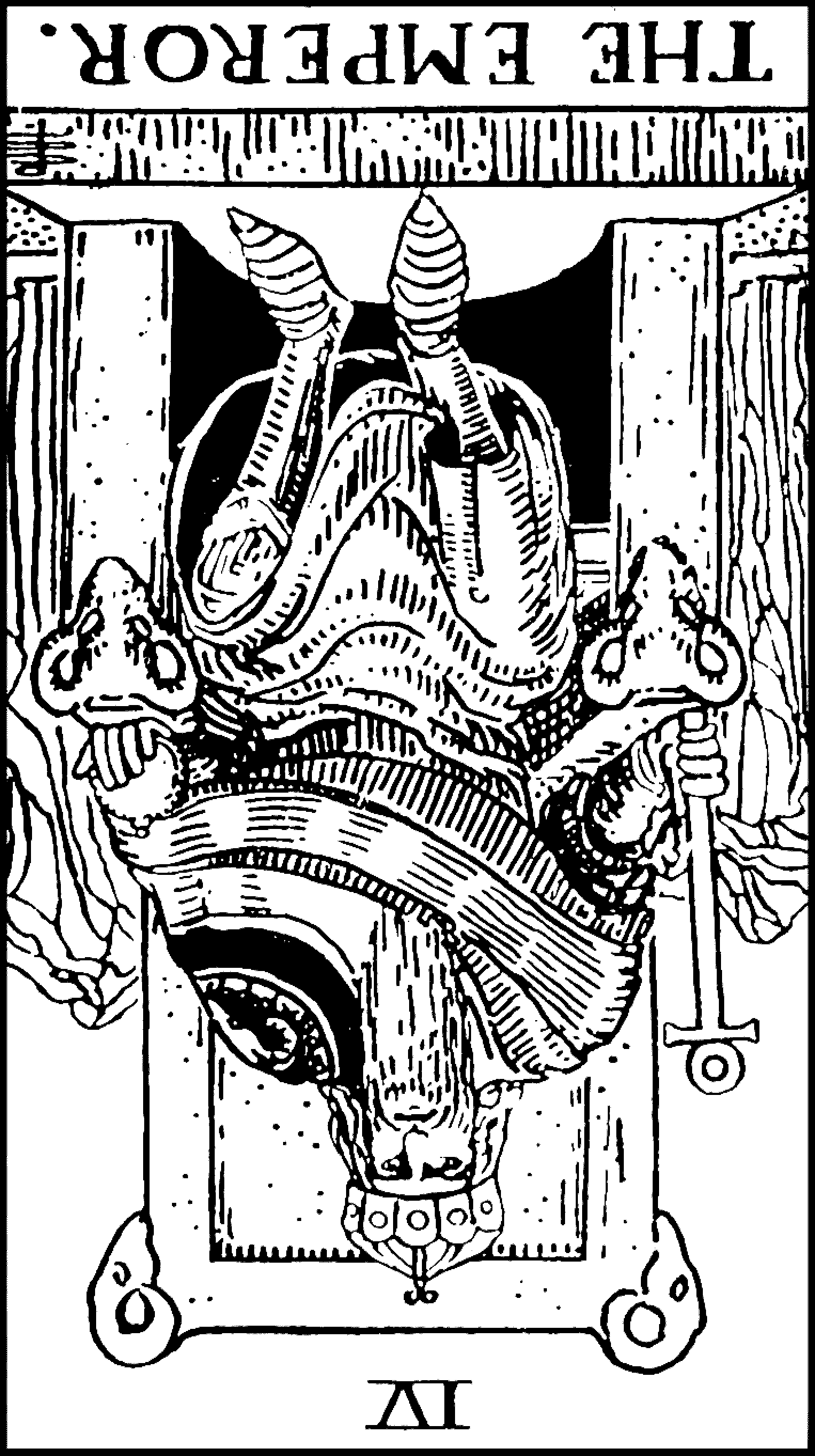
This week we pulled the Emperor (reversed). Moorings are loose, foundations are cracking, their features becoming diffuse. Time to retreat and strengthen.
Our first hexagram this week is #50, The Cauldron. The image here is of a cauldron, the vessel that holds nourishment to feed a large group of people. But the emphasis is not on the ingredients or the iron that contains and cooks, but of the outer system, of elements like rain and sun, that make the specific process possible. The far, far off sun and the rain (fickle or persistent as it may be) are what truly make the cauldron’s nourishment possible. As the degree to which wood delivers a robust flame depends upon the strength of the relation of the tree and its environment — the sun and rain being the foundational elements of this production. The I Ching states that this cumulative image represents the need for religion, that is, the group/societal reverence of god — and that it is only with such religious unity that a society or individual can thrive. It is important to note that the I Ching was written at least 2,000-3,000 years ago in the China of antiquity. Here in 2025/26 things are somewhat different. Though we don’t feel it is religion or the worship of some sort of god that is important for successful societies and individual thriving — shared group reverence for an ideal of something like Love, combined with a shared group awe and respect of the world and the cosmos, is fundamental for societal and individual blossoming.
There was one change of which the specific note is: no matter one’s position, persistent good will yield success.
Our second hexagram, the one that suggests how best to meet the challenges (or the changes) is #14, Possession in Great Measure. “Possession in great measure is determined by fate and accords with the time…” It is accomplished by the “virtue of unselfish modesty.” All over the I Ching are notes regarding the idea that things can’t be forced, that events and arrivals only happen “in their own time.” This hexagram is like a singular attestation of this idea. “This hexagram shows the clouds in the heavens, giving rain to refresh all that grows and to provide humankind with food and drink. The rain will come in its own time. We cannot make it come; we have to wait for it.” “Waiting is not mere empty hoping. It has the inner certainty of reaching the goal. Such certainty alone gives that light which leads to success. This leads to the perseverance that brings good fortune and bestows power… Weakness and impatience can do nothing. Only a strong person can stand up to their fate, for their inner security enables them to endure to the end. This strength shows itself in uncompromising truthfulness [with themself]. It is only when we have the courage to face things exactly as they are, without any sort of self–deception or illusion, that a light will develop out of events, by which the path to success may be recognized. This recognition must be followed by resolute and persevering action. For only the person who goes to meet their fate resolutely is equipped to deal with it adequately. Then they will be able to cross the great water — that is to say, they will be capable of making the necessary decision and of surmounting the danger.”