Dec 17 25
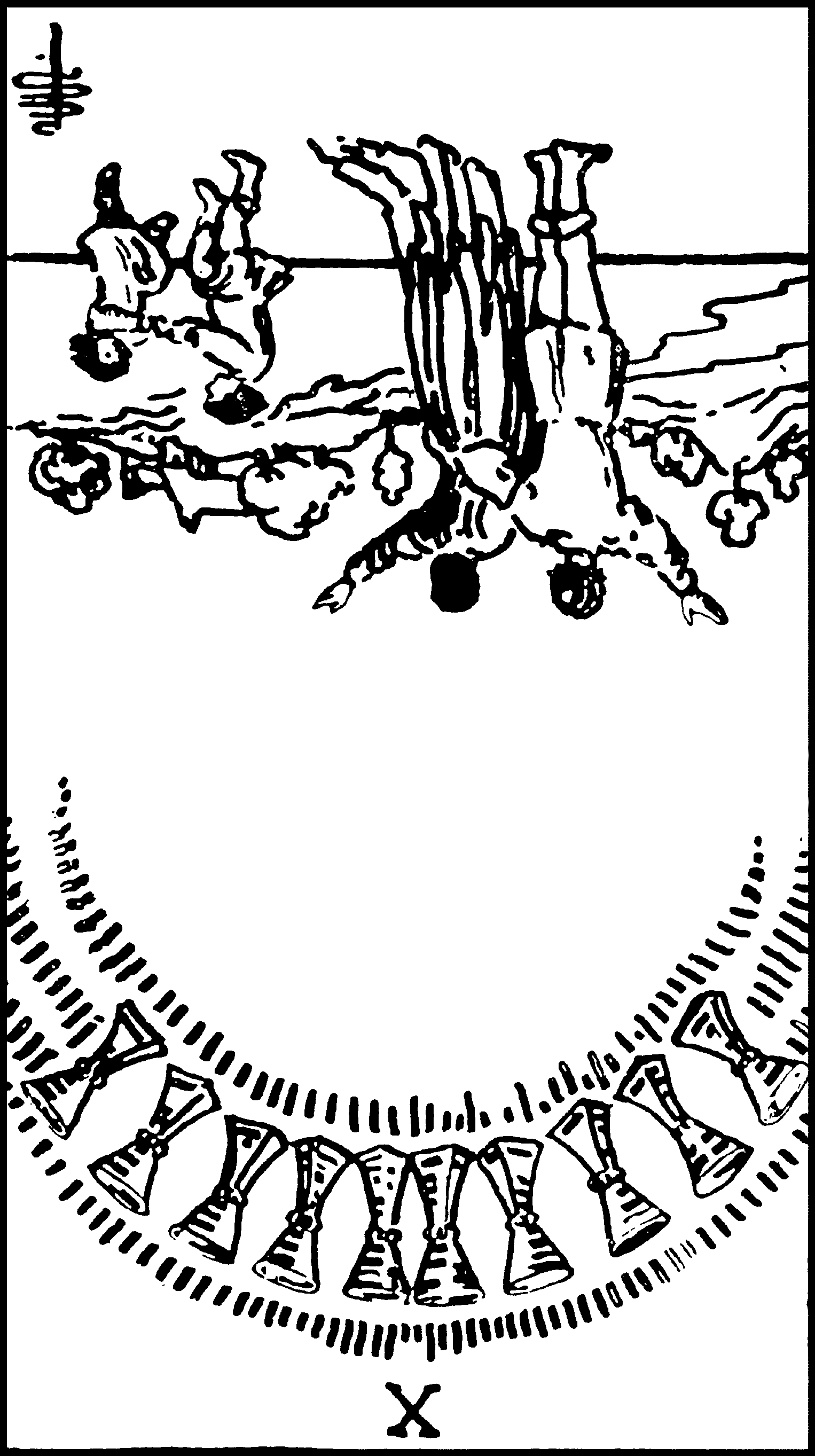
Ten of Cups (reversed)

14. Possession in Great Measure
54. The Marrying Maiden
These first few lines are the general aphoristic returns for the week. They are raw and uninterpreted; there to use how you’d like. (The specific readings follow.)
Question from “V.C.R.”: We’ve been strongly informed by Lacan’s and Derrida’s notions (respectively →) of unstable subjectivity (the barred subject, etc.) and the nonexistence of transcendental signifiers. (Three notes: 1. We have been interested in many ideas but these have persisted significantly through the years, so the following is not a casual question. 2. We understand that this is a truncation of complex ideas. 3. We know the following question has been addressed by Lacan and Derrida directly, themselves.)
The effect of accepting the ideas of the barred subject and the non-existence of transcendental signifiers comes with a significant depressive impact. As well, wholly accepting the ideas are impossible, self-centeredness and unconscious relinquishment to all manner of rhythm (transcendental economy) is inescapable for us humans.
What is the oracle’s advice for facing these realities head-on whilst not being overwhelmed by them?
Oracle reply: These are theories not absolutes. Theories which themselves call into question absolutes. When something is truly uncertain you can’t place a final judgment on it. You can project your fears and/or desires onto the blankness (or un-fixedness) but it is going to breed deep irreconcilable confusion — which will be very unproductive over time.
As well, if something appears as uncertain it may only appear that way from your vantage, your context, your human-ness. No one knows.
There is an openness in these thinkers. Join them in their questioning and channeling; don’t insult them by fixing them down.
Acute awareness is a kind of horror in its own right; consider developing a serious practice of meditation —
to learn (occasional) release from awareness.
Complete Reading:
This week we pulled the Ten of Cups (reversed). When upright the implication is domestic harmony, generally, that all is in order in one’s immediate sphere. When reversed, as it is here, a “false god” is being worshipped, an imitation has been vaulted — the termites are being ignored and the structure of the “home” is being compromised. You can’t have it all so choose that which is healthy and healing (this is obviously not always straightforward).
Our first hexagram this week is #14, Possession in Great Measure. “The sun brings both evil and good into the light of day” — it is the symbol here of possession. The illumination it sheds is best met by a person who is “modest and kind in a high position.” A person who aspires to “unselfish modesty,... strength within, clarity and culture without.” When this type of order is pursued sincerely/seriously, power will issue from them in a “graceful and controlled way.”
There was one change of which the specific note is: private property is to be shared. Ownership is necessary (the private property part) but should mean stewardship and protection (to ensure longevity, respect, etc.), but still very much shared.
Our second hexagram, the one that suggests how best to meet the challenges (or the changes) is #54, The Marrying Maiden. “Affection as the essential principle of relatedness is of the greatest importance in all relationships in the world. For the union of heaven and earth is the origin of the whole of nature. Among human beings likewise, spontaneous affection is the all-inclusive principle of union.” “Spontaneous affection” of molecules, “spontaneous affection” of cell growth (even the harmful kind), “spontaneous affection” of words in a sentence, and on and on. Affection, never imposition; one should never force oneself on situations but be sincere and employ tactful reserve.
- False certainty causes chaos.
- “Unselfish modesty, strength within, clarity and culture without... all in a graceful and controlled way.”
- Be sincere and employ tactful reserve.
Question from “V.C.R.”: We’ve been strongly informed by Lacan’s and Derrida’s notions (respectively →) of unstable subjectivity (the barred subject, etc.) and the nonexistence of transcendental signifiers. (Three notes: 1. We have been interested in many ideas but these have persisted significantly through the years, so the following is not a casual question. 2. We understand that this is a truncation of complex ideas. 3. We know the following question has been addressed by Lacan and Derrida directly, themselves.)
The effect of accepting the ideas of the barred subject and the non-existence of transcendental signifiers comes with a significant depressive impact. As well, wholly accepting the ideas are impossible, self-centeredness and unconscious relinquishment to all manner of rhythm (transcendental economy) is inescapable for us humans.
What is the oracle’s advice for facing these realities head-on whilst not being overwhelmed by them?
Oracle reply: These are theories not absolutes. Theories which themselves call into question absolutes. When something is truly uncertain you can’t place a final judgment on it. You can project your fears and/or desires onto the blankness (or un-fixedness) but it is going to breed deep irreconcilable confusion — which will be very unproductive over time.
As well, if something appears as uncertain it may only appear that way from your vantage, your context, your human-ness. No one knows.
There is an openness in these thinkers. Join them in their questioning and channeling; don’t insult them by fixing them down.
Acute awareness is a kind of horror in its own right; consider developing a serious practice of meditation —
to learn (occasional) release from awareness.
Complete Reading:
This week we pulled the Ten of Cups (reversed). When upright the implication is domestic harmony, generally, that all is in order in one’s immediate sphere. When reversed, as it is here, a “false god” is being worshipped, an imitation has been vaulted — the termites are being ignored and the structure of the “home” is being compromised. You can’t have it all so choose that which is healthy and healing (this is obviously not always straightforward).
Our first hexagram this week is #14, Possession in Great Measure. “The sun brings both evil and good into the light of day” — it is the symbol here of possession. The illumination it sheds is best met by a person who is “modest and kind in a high position.” A person who aspires to “unselfish modesty,... strength within, clarity and culture without.” When this type of order is pursued sincerely/seriously, power will issue from them in a “graceful and controlled way.”
There was one change of which the specific note is: private property is to be shared. Ownership is necessary (the private property part) but should mean stewardship and protection (to ensure longevity, respect, etc.), but still very much shared.
Our second hexagram, the one that suggests how best to meet the challenges (or the changes) is #54, The Marrying Maiden. “Affection as the essential principle of relatedness is of the greatest importance in all relationships in the world. For the union of heaven and earth is the origin of the whole of nature. Among human beings likewise, spontaneous affection is the all-inclusive principle of union.” “Spontaneous affection” of molecules, “spontaneous affection” of cell growth (even the harmful kind), “spontaneous affection” of words in a sentence, and on and on. Affection, never imposition; one should never force oneself on situations but be sincere and employ tactful reserve.