Dec 03 24
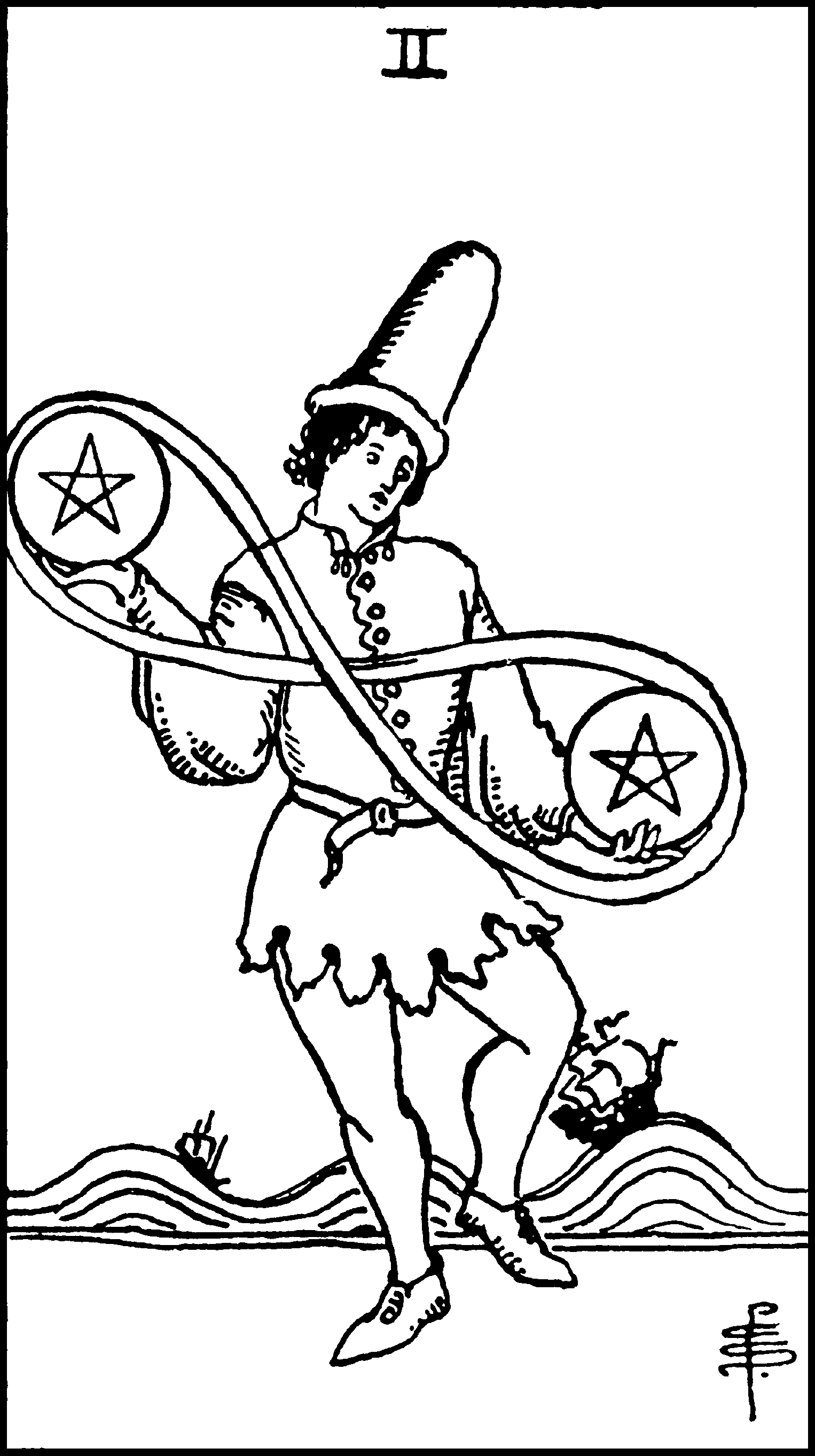
Two of Pentacles

32. Duration
60. Limitation
These first few lines are the general aphoristic returns for the week. They are raw and uninterpreted; there to use how you’d like. (The specific readings follow.)
From “M.S.”: What is the best way to not lose self when joining “the” group? (We want to both grow/strengthen as an individual and contribute to the various spheres of our interdependence.)
There is no trick to life but trying — that is, trying to be adaptive but also trying to have a constant character. Because all is change, adaption is necessary, but since adaptation requires some foreknowledge, there needs to be a durability in one’s sense of self.
It takes persistence to get to any semblance of balance between groups physics and self physics — it’s almost as mind bending as the difference between terrestrial physics and quantum physics.
Perhaps knowing the incommensurability of these two zones, the group and the self is the start. An analogy — a scuba diver survives under water by bringing a mask and a tank of oxygen — the ocean is the group your sense of self is the mask/oxygen. Don’t prepare for the group setting by a false sense of integration.
Complete Reading
This week we pulled the Two of Pentacles. Stability requires endless attention and alertness. Therefore it not possible to achieve permanently — but since the desire for constancy lies at the heart of all of our beings, we must have realistic relation to change.
Our first hexagram this week is 32, Duration. Life as it’s experienced by humans is specific but the laws that determine the specificity are general and (at scale) are constant. “Thunder rolls, and the wind blows; both are examples of extreme mobility and so are seemingly the very opposite of permanence, but the laws governing their appearance and subsidence, their coming and going, endure. In the same way the independence of the superior person is not based on rigidity and immobility of character. They always keep abreast of the time and changes with it. What endures is the unswerving directive, the inner law of their being, which determines all their actions.”
There were four changes this week of which the specific notes are: those who want too much at once usually get nothing, “if a person remains at the mercy of moods of hope or fear aroused by the outer world, they lose their inner consistency of character” and “persistence in search is not enough — what is not sought in the right way is not found.”
Our second hexagram or how best to meet the changes is #60, Limitation. Without a boundary there is no substance, no meaning. But humans like all animals need to be free of mind to find ways to adapt for survival. Therefore it is (of course) wise to set limitations but additionally wise “to set limits even upon limitation.”
- There is no trick to life but trying.
- Change and the need for constancy are eternally at odds — therefore the relation must be treated realistically. Maybe learn to revere the tension.
- We are specific incarnations of general processes — it is often hard to see this in the midst of all this specificity.
- Wanting too much at once often begets nothing.
- “If a person remains at the mercy of moods of hope or fear aroused by the outer world, they lose their inner consistency of character.”
- “Persistence in search is not enough — what is not sought in the right way is not found.”
- Limitations are foundational for meaning but flexibility and adaptation are equally important, so one must “set limits even upon limitation.”
From “M.S.”: What is the best way to not lose self when joining “the” group? (We want to both grow/strengthen as an individual and contribute to the various spheres of our interdependence.)
There is no trick to life but trying — that is, trying to be adaptive but also trying to have a constant character. Because all is change, adaption is necessary, but since adaptation requires some foreknowledge, there needs to be a durability in one’s sense of self.
It takes persistence to get to any semblance of balance between groups physics and self physics — it’s almost as mind bending as the difference between terrestrial physics and quantum physics.
Perhaps knowing the incommensurability of these two zones, the group and the self is the start. An analogy — a scuba diver survives under water by bringing a mask and a tank of oxygen — the ocean is the group your sense of self is the mask/oxygen. Don’t prepare for the group setting by a false sense of integration.
This week we pulled the Two of Pentacles. Stability requires endless attention and alertness. Therefore it not possible to achieve permanently — but since the desire for constancy lies at the heart of all of our beings, we must have realistic relation to change.
Our first hexagram this week is 32, Duration. Life as it’s experienced by humans is specific but the laws that determine the specificity are general and (at scale) are constant. “Thunder rolls, and the wind blows; both are examples of extreme mobility and so are seemingly the very opposite of permanence, but the laws governing their appearance and subsidence, their coming and going, endure. In the same way the independence of the superior person is not based on rigidity and immobility of character. They always keep abreast of the time and changes with it. What endures is the unswerving directive, the inner law of their being, which determines all their actions.”
There were four changes this week of which the specific notes are: those who want too much at once usually get nothing, “if a person remains at the mercy of moods of hope or fear aroused by the outer world, they lose their inner consistency of character” and “persistence in search is not enough — what is not sought in the right way is not found.”
Our second hexagram or how best to meet the changes is #60, Limitation. Without a boundary there is no substance, no meaning. But humans like all animals need to be free of mind to find ways to adapt for survival. Therefore it is (of course) wise to set limitations but additionally wise “to set limits even upon limitation.”