Jun 03 25
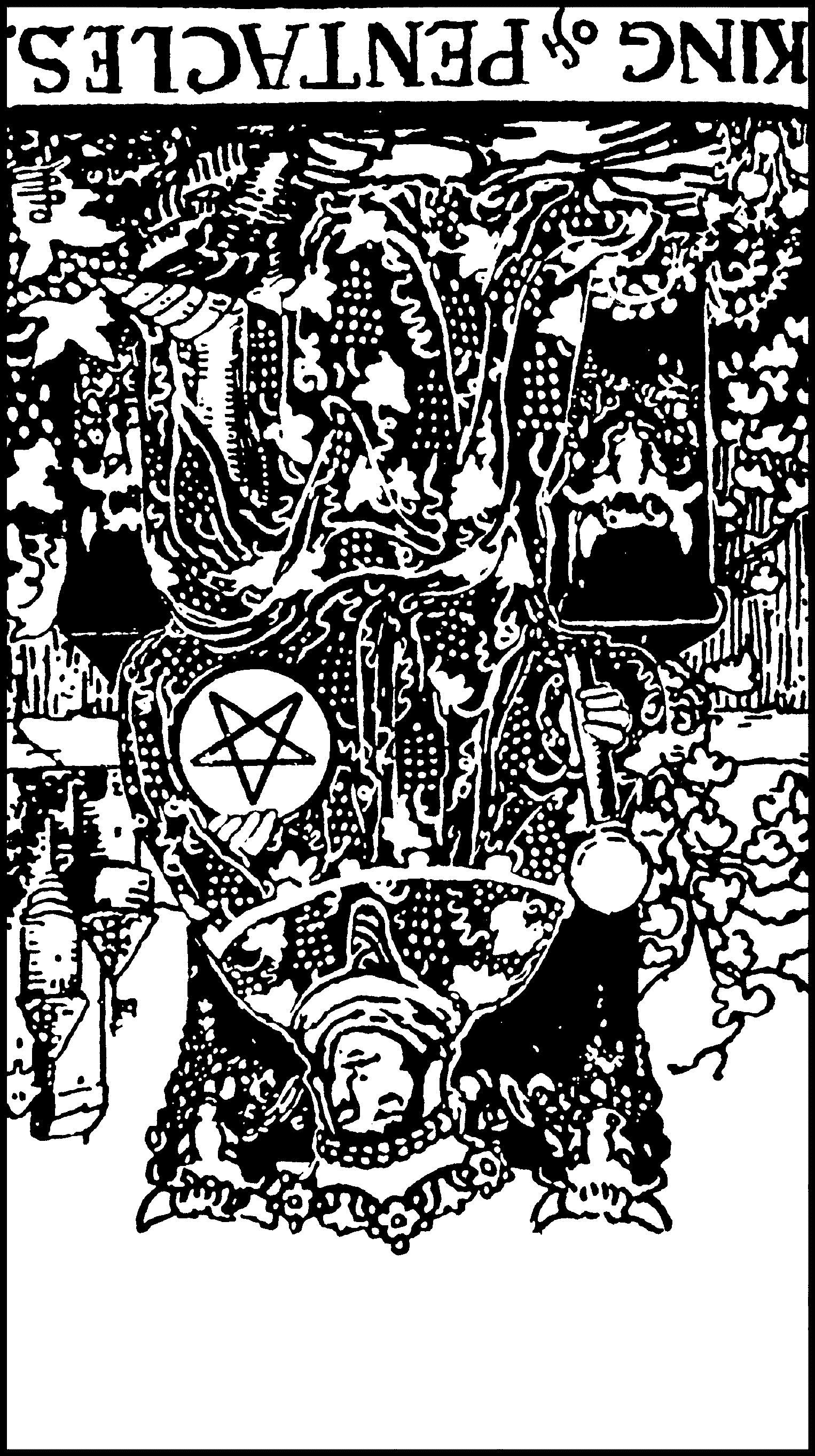
King of Pentacles (reversed)

56. The Wanderer
50. The Cauldron
These first few lines are the general aphoristic returns for the week. They are raw and uninterpreted; there to use how you’d like. (The specific readings follow.)
Question from “L.P.”: Due to deep seated childhood issues — we have a severe tendency to need to believe that there is a shared basic morality with strangers/people (particularly in the realm of quotidian manners/decorum); ever more this seems a foolish presumption/mode. We know there is little we can do about changing the course of a world transcendentally inculcated to narcissistically believe in the supremacy of self — that is, trained to feel that ALL Others (whomever they may be) mean you harm, but somehow you are the best (this fictitious, cheap promotion, actually being a process of corporate self concealment, to hide the ACTUAL transcendental harm that their platforms are doing). But overall we feel very naive (and not a little disgusted — self included) to live in a world where the most casual interactions are transmogrified into front line like, government-level importance; again though, we feel quite immature, what can we do to be less so?
Oracle reply: If you are in an extreme minority you are (like it or not) an outsider. It is not wise for you to be pushy or demand accord. It doesn’t mean that you are “wrong” or “right”, just that you are outnumbered, so should behave accordingly.
The outsider is only balanced if they recognize themself as such.
No one person has the whole story so your position is a deficiency of perspective; you are right in feeling naive and immature (apologies for harshness). Outsiderness brings unique abilities — just stop trying to get the entirety of society to match them.
Your healthy move is to cultivate modesty and reserve without losing touch with your distinctive awareness. Inwardly, you must stoke these fertile peculiarities. Unless you are a sociopath or psychopath this will be beneficial for you and all you come in contact with.
Complete Reading:
This week we pulled the King of Pentacles (reversed). Basic aptitudes are off. The governance of a balanced self (the accord of the body, the emotions, intuition, receptivity, the unconscious, the intellect, and communication) is insecure or fatigued. One must bring power back (to themself) by engaging (with the goal of mastering) the balanced self.
Our first hexagram this week is #56, The Wanderer. “Life itself is an exile. The way home is not the way back.” This hexagram is all about keeping it light — particularly when one is (as we all are most of the time) a snail between shells. When you are searching don’t get caught up. Don’t strike up a relationship (with an idea, object or person) until you are sure it is appropriate. “When a person is a wanderer and stranger, they should not be gruff nor overbearing. They have no large circle of acquaintances, therefore they should not give themself airs. They must be cautious and reserved; in this way they protect themself from evil. If one is obliging toward others, they win success.” “Strange lands and separation are the wanderer’s lot... Therefore they must take care to remain upright and steadfast, so that they sojourn only in the proper places, associating only with good people. Then they have good fortune and can go on their way unmolested.”
There was one change this week of which the specific note is: when seeking and wandering one should be modest and reserved and never lose touch with one’s inner being — such behavior will encourage people to assist you.
Our second hexagram, the one that suggests how best to meet the challenges (or the changes) is #50, The Cauldron. A cauldron holds nourishment to feed a large group of people. The emphasis here, is not on the ingredients though, or the iron that constructs it, but of the rain and sun. The far, far off sun and the rain (fickle or persistent as they may be) are what truly make the cauldron’s nourishment possible. As well, the degree to which wood delivers a robust flame, depends upon the strength of the relation of the tree and its environment — the sun and rain being the foundational elements of this production. The I Ching states that this cumulative image represents the need for group spirituality, that is, society needs a unified reverence of the larger mystery and out of reach forces, for large scale nourishment to exist — isolated, cynical, individuality will only bring strife.
- Balancing the physical self, the emotions, intuition, receptivity, the unconscious, the intellect, and communication — is the only goal.
- “The way home is not the way back.”
- When seeking, between shells, don’t strike up a relationship (with an idea, object or person) until you are sure it is appropriate.
- Community spiritual accord is the only way.
Question from “L.P.”: Due to deep seated childhood issues — we have a severe tendency to need to believe that there is a shared basic morality with strangers/people (particularly in the realm of quotidian manners/decorum); ever more this seems a foolish presumption/mode. We know there is little we can do about changing the course of a world transcendentally inculcated to narcissistically believe in the supremacy of self — that is, trained to feel that ALL Others (whomever they may be) mean you harm, but somehow you are the best (this fictitious, cheap promotion, actually being a process of corporate self concealment, to hide the ACTUAL transcendental harm that their platforms are doing). But overall we feel very naive (and not a little disgusted — self included) to live in a world where the most casual interactions are transmogrified into front line like, government-level importance; again though, we feel quite immature, what can we do to be less so?
Oracle reply: If you are in an extreme minority you are (like it or not) an outsider. It is not wise for you to be pushy or demand accord. It doesn’t mean that you are “wrong” or “right”, just that you are outnumbered, so should behave accordingly.
The outsider is only balanced if they recognize themself as such.
No one person has the whole story so your position is a deficiency of perspective; you are right in feeling naive and immature (apologies for harshness). Outsiderness brings unique abilities — just stop trying to get the entirety of society to match them.
Your healthy move is to cultivate modesty and reserve without losing touch with your distinctive awareness. Inwardly, you must stoke these fertile peculiarities. Unless you are a sociopath or psychopath this will be beneficial for you and all you come in contact with.
Complete Reading:
This week we pulled the King of Pentacles (reversed). Basic aptitudes are off. The governance of a balanced self (the accord of the body, the emotions, intuition, receptivity, the unconscious, the intellect, and communication) is insecure or fatigued. One must bring power back (to themself) by engaging (with the goal of mastering) the balanced self.
Our first hexagram this week is #56, The Wanderer. “Life itself is an exile. The way home is not the way back.” This hexagram is all about keeping it light — particularly when one is (as we all are most of the time) a snail between shells. When you are searching don’t get caught up. Don’t strike up a relationship (with an idea, object or person) until you are sure it is appropriate. “When a person is a wanderer and stranger, they should not be gruff nor overbearing. They have no large circle of acquaintances, therefore they should not give themself airs. They must be cautious and reserved; in this way they protect themself from evil. If one is obliging toward others, they win success.” “Strange lands and separation are the wanderer’s lot... Therefore they must take care to remain upright and steadfast, so that they sojourn only in the proper places, associating only with good people. Then they have good fortune and can go on their way unmolested.”
There was one change this week of which the specific note is: when seeking and wandering one should be modest and reserved and never lose touch with one’s inner being — such behavior will encourage people to assist you.
Our second hexagram, the one that suggests how best to meet the challenges (or the changes) is #50, The Cauldron. A cauldron holds nourishment to feed a large group of people. The emphasis here, is not on the ingredients though, or the iron that constructs it, but of the rain and sun. The far, far off sun and the rain (fickle or persistent as they may be) are what truly make the cauldron’s nourishment possible. As well, the degree to which wood delivers a robust flame, depends upon the strength of the relation of the tree and its environment — the sun and rain being the foundational elements of this production. The I Ching states that this cumulative image represents the need for group spirituality, that is, society needs a unified reverence of the larger mystery and out of reach forces, for large scale nourishment to exist — isolated, cynical, individuality will only bring strife.