Apr 01 25
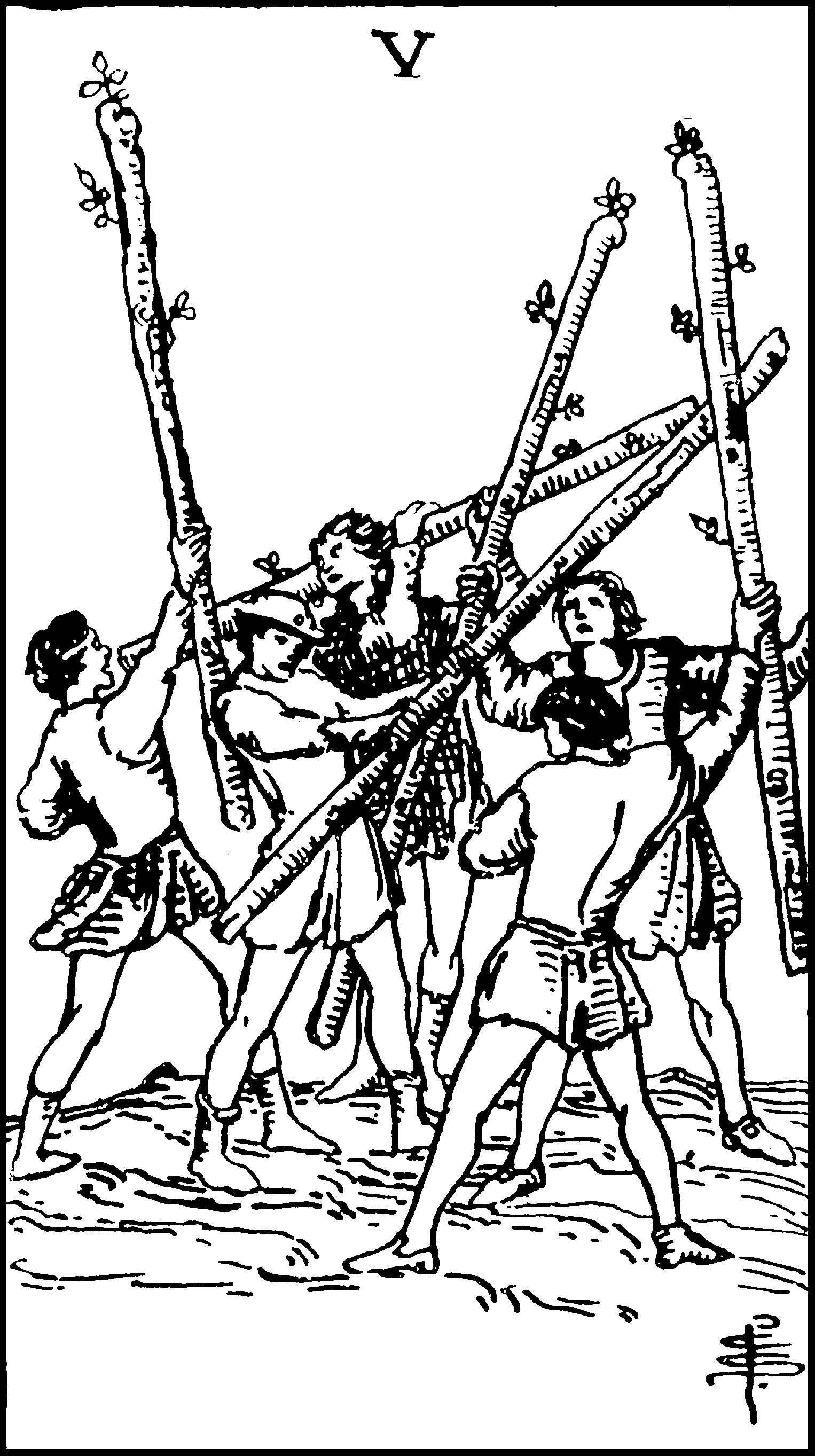
Five of Wands

53. Development / Gradual Progress
20. Contemplation / Viewing
These first few lines are the general aphoristic returns for the week. They are raw and uninterpreted; there to use how you’d like. (The specific readings follow.)
From “MS”: We are pretty sure we know what the I Ching’s views are on a single person being against their times – likely, that it is unwise in the extreme — that is, to be a microscopic entity and think that pushing against a full-on meta force would have any effect, but to be crushed (without notice). But what if one has no choice? What if one feels almost completely out of sync with one’s time/era? (And to be sure, we don’t feel that there was anything like a better era.) Suffice it to say we feel little to zero accord with the movements, people, perceptions, tactics, etc. of our time.
As we have said before, it is our feeling that at its basis life on earth is a clash of complex “systems” coming in contact with other complex “systems” (and not just two at a time, but incalculable amounts) which OF COURSE invariably yield almost completely unforeseeable (unforeseen) consequences. (Further, humanity’s endless/constant ability to barter in “views” constructed of absolute hindsight, from these unforeseen outcomes, pretending that they were real-time observations, seriously challenges our suicidal tendencies.) But everywhere only Sneetches, all meretriciously yelling, getting evermore locked into corporate tracks, fatalistically gilding their fake steering wheels.
We guess our question is this, any advice for heretics?
Struggle is life, though specific struggles should not be long standing. They waste non-renewable resources, like time. Retreat is wise. [Retreat has two meanings, a place to collect oneself out of the fray (to restore/reflect/learn) — and to remove oneself from a direct conflict (sometimes risking surrender)]. Continued struggle will blind you to incremental progress.
Secondly, there is clear advice here for action. And please note the I Ching did not say that standing apart from major currents isn’t wise — in fact it gives a beautiful reply, invoking images of ancient sages and their public visibility. Holy people did not go with the flow of human life, like you they were likely dissatisfied. They put their dignified dissatisfaction and subsequent transcendent quest on display.
So, retreat (to collect, renew and learn) then live as a “heretic” in the open (art, and the like, come to mind here).
Complete Reading
This week we pulled the Five of wands. Here, competition is a central aspect of life (the process of survival) — both as seen in play as well as directly and constantly. This is not referring to a special scenario of intense clashing, like a fight to the death. This is a push to accept competition as normal and healthy (annoying and/or dispiriting as it may sometimes be).
Our first hexagram this week is #53, Development, Gradual Progress. This hexagram speaks of “obstacles that cannot be overcome directly.” Then, that retreat and reflective pause are the only ways to healthily return to moving forward. It also recommends joining with friends for strength and relinquishing yourself to another’s leadership. Ultimately its advice is optimistic: “An obstruction that lasts only for a time is useful for self–development. This is the value of adversity.”
There was one change this week, of which the specific note is: conflict is unavoidable in life but it should not be sought, as it is a result — a fool willingly wastes their resources.
Our second hexagram, the one that suggests how best to meet the challenges (or the changes) is #20, Contemplation, Viewing. Here we have a lovely exposition of spiritual development/aspiration. In ancient China holy people could be seen in high areas, in full view of the public, meditating in rapt contemplation. The metaphor is beautiful because it is double. The holy people contemplated spiritual things in public, so as the public could contemplate them (the holy people). The sage’s deep struggles and commitment were not private thus becoming a wheel of mutually enriching and aspirational contemplation. Also there is a strong message here of living as an example, that is, living an exemplary life as visible example... “A slight variation of tonal stress gives the Chinese name for this hexagram a double meaning. It means both contemplating and being seen, in the sense of being an example. These ideas are suggested by the fact that the hexagram can be understood as picturing a type of tower characteristic of ancient China… A tower of this kind commanded a wide view of the country; at the same time, when situated on a mountain, it became a landmark that could be seen for miles around.”
- Competition must be accepted as a normative part of existence, for proper functioning.
- Similar to the above, adversity is part of a healthy life (just as it doesn’t last too long — if so, something is wrong and needs to be addressed).
- Retreat is absolutely necessary in some scenarios.
- Conflict is unavoidable in life but it should not be sought, as it is a result.
- A fool willingly wastes their resources.
- Sincere (as is possible) acts should not be kept wholly private. If they are true they will be a source of inspiration to others.
From “MS”: We are pretty sure we know what the I Ching’s views are on a single person being against their times – likely, that it is unwise in the extreme — that is, to be a microscopic entity and think that pushing against a full-on meta force would have any effect, but to be crushed (without notice). But what if one has no choice? What if one feels almost completely out of sync with one’s time/era? (And to be sure, we don’t feel that there was anything like a better era.) Suffice it to say we feel little to zero accord with the movements, people, perceptions, tactics, etc. of our time.
As we have said before, it is our feeling that at its basis life on earth is a clash of complex “systems” coming in contact with other complex “systems” (and not just two at a time, but incalculable amounts) which OF COURSE invariably yield almost completely unforeseeable (unforeseen) consequences. (Further, humanity’s endless/constant ability to barter in “views” constructed of absolute hindsight, from these unforeseen outcomes, pretending that they were real-time observations, seriously challenges our suicidal tendencies.) But everywhere only Sneetches, all meretriciously yelling, getting evermore locked into corporate tracks, fatalistically gilding their fake steering wheels.
We guess our question is this, any advice for heretics?
Struggle is life, though specific struggles should not be long standing. They waste non-renewable resources, like time. Retreat is wise. [Retreat has two meanings, a place to collect oneself out of the fray (to restore/reflect/learn) — and to remove oneself from a direct conflict (sometimes risking surrender)]. Continued struggle will blind you to incremental progress.
Secondly, there is clear advice here for action. And please note the I Ching did not say that standing apart from major currents isn’t wise — in fact it gives a beautiful reply, invoking images of ancient sages and their public visibility. Holy people did not go with the flow of human life, like you they were likely dissatisfied. They put their dignified dissatisfaction and subsequent transcendent quest on display.
So, retreat (to collect, renew and learn) then live as a “heretic” in the open (art, and the like, come to mind here).
Complete Reading
This week we pulled the Five of wands. Here, competition is a central aspect of life (the process of survival) — both as seen in play as well as directly and constantly. This is not referring to a special scenario of intense clashing, like a fight to the death. This is a push to accept competition as normal and healthy (annoying and/or dispiriting as it may sometimes be).
Our first hexagram this week is #53, Development, Gradual Progress. This hexagram speaks of “obstacles that cannot be overcome directly.” Then, that retreat and reflective pause are the only ways to healthily return to moving forward. It also recommends joining with friends for strength and relinquishing yourself to another’s leadership. Ultimately its advice is optimistic: “An obstruction that lasts only for a time is useful for self–development. This is the value of adversity.”
There was one change this week, of which the specific note is: conflict is unavoidable in life but it should not be sought, as it is a result — a fool willingly wastes their resources.
Our second hexagram, the one that suggests how best to meet the challenges (or the changes) is #20, Contemplation, Viewing. Here we have a lovely exposition of spiritual development/aspiration. In ancient China holy people could be seen in high areas, in full view of the public, meditating in rapt contemplation. The metaphor is beautiful because it is double. The holy people contemplated spiritual things in public, so as the public could contemplate them (the holy people). The sage’s deep struggles and commitment were not private thus becoming a wheel of mutually enriching and aspirational contemplation. Also there is a strong message here of living as an example, that is, living an exemplary life as visible example... “A slight variation of tonal stress gives the Chinese name for this hexagram a double meaning. It means both contemplating and being seen, in the sense of being an example. These ideas are suggested by the fact that the hexagram can be understood as picturing a type of tower characteristic of ancient China… A tower of this kind commanded a wide view of the country; at the same time, when situated on a mountain, it became a landmark that could be seen for miles around.”