Nov 08 24
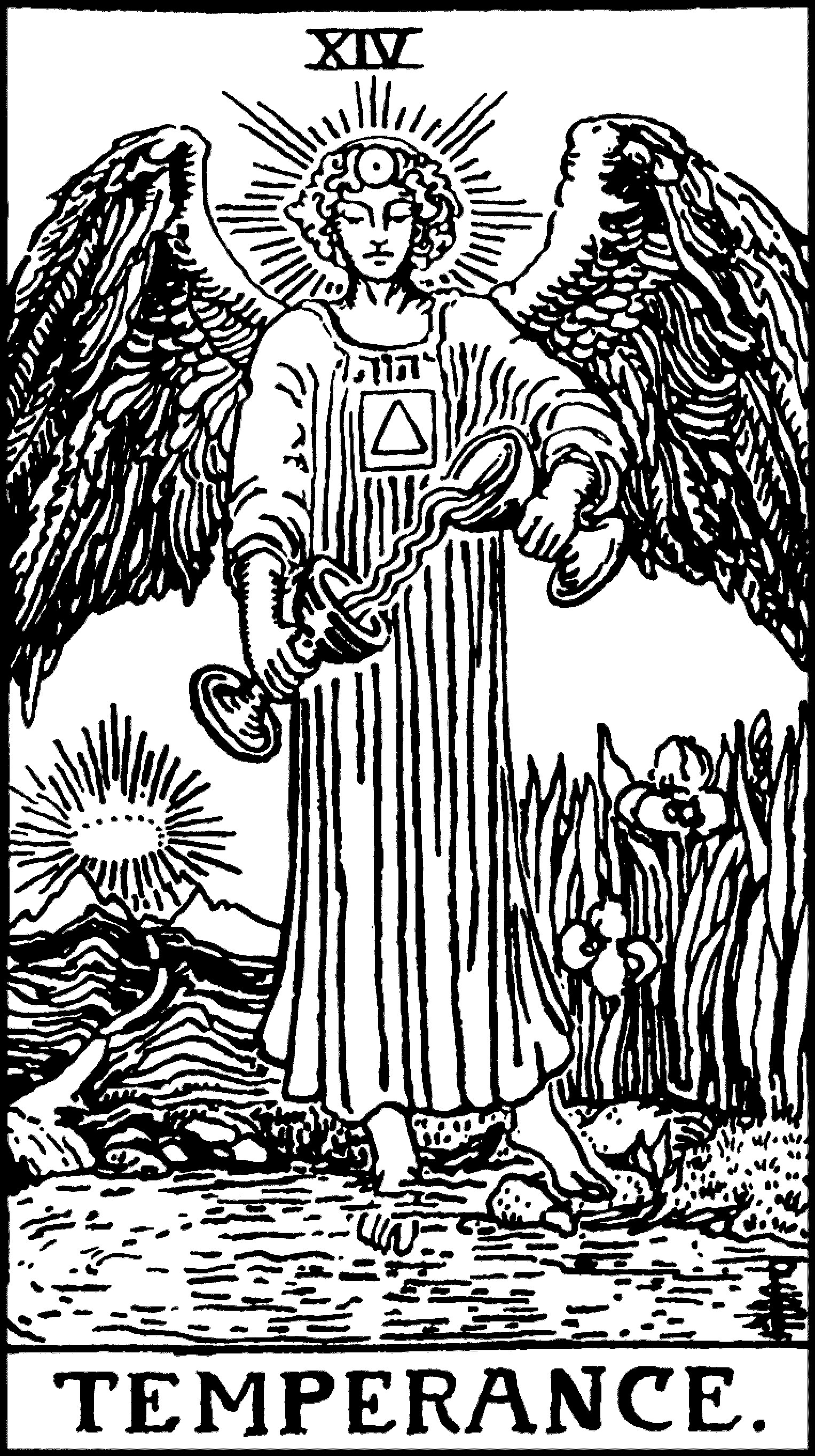
Temperance

20. Contemplation (View)
17. Following
These first few lines are the general aphoristic returns for the week. They are raw and uninterpreted; there to use how you’d like. (The specific readings follow.)
From “M.S.”: Memory and expectation (“D”esire) breed both blind satiation and disturbing surprise — what is an effective practice to get our often faulty ratios of memory and expectation to breed more consistent, healthy outcomes?
One must try to not live in a dream. Of course, as has been said by many, life is indistinguishable from a dream. (Not just speaking semantically here.) In this case one must understand that everyone’s situation is causally arrived at — interconnected.
To have “healthy outcomes” you have to struggle to see the interwoven/inter-defining aspects of “healthy outcomes” — with tenacity, love, courage, and constant self reproach/reflection.
Complete Reading
This week we pulled the Temperance card. Restraint vibrates somewhere between control and acceptance. With both cases it is a kind of knowledge. If it is sought, it is to be an awareness of parameters.
Our first hexagram this week is 20, Contemplation (View). “A slight variation of tonal stress gives the Chinese name for this hexagram a double meaning. It means both contemplating and being seen, in the sense of being an example. These ideas are suggested by the fact that the hexagram can be understood as picturing a type of tower characteristic of ancient China… A tower of this kind commanded a wide view of the country; at the same time, when situated on a mountain, it became a landmark that could be seen for miles around.” So it suggested, that if you have a broad, encompassing outlook make sure it is seen by many people, as an ideal of conduct.
There were three changes this week of which the specific notes are: the superlative person, at all times, tries to see the interconnected forces that make up their world — as well, they struggle to cleanse the information of mere personal validation.
Our second hexagram or how best to meet the changes is #17, Following. Herein some meditations on leadership: “If a person is to rule they must first learn to serve.” “If a person tries to obtain a following by force or cunning, by conspiracy or by creating factions, they invariably arouse resistance.” “Obtaining a following through adaptation to the demands of the time is a great and significant idea.” “No situation can become favorable until one is able to adapt to it and does not wear themself out with mistaken resistance.”
- Restraint comes from a transcendental awareness of parameters.
- If you are an ideal of conduct, or you know someone to be an ideal of conduct, to be truly ideal the person and conduct must be visible — as to be an example.
- It is important to see the interconnectedness that makes up any given moment — but only if that includes the necessary warts and darkness.
- To lead is to serve.
- One must always adapt, to a significant degree — and not wear themselves out with “mistaken resistance.”
From “M.S.”: Memory and expectation (“D”esire) breed both blind satiation and disturbing surprise — what is an effective practice to get our often faulty ratios of memory and expectation to breed more consistent, healthy outcomes?
One must try to not live in a dream. Of course, as has been said by many, life is indistinguishable from a dream. (Not just speaking semantically here.) In this case one must understand that everyone’s situation is causally arrived at — interconnected.
To have “healthy outcomes” you have to struggle to see the interwoven/inter-defining aspects of “healthy outcomes” — with tenacity, love, courage, and constant self reproach/reflection.
Complete Reading
This week we pulled the Temperance card. Restraint vibrates somewhere between control and acceptance. With both cases it is a kind of knowledge. If it is sought, it is to be an awareness of parameters.
Our first hexagram this week is 20, Contemplation (View). “A slight variation of tonal stress gives the Chinese name for this hexagram a double meaning. It means both contemplating and being seen, in the sense of being an example. These ideas are suggested by the fact that the hexagram can be understood as picturing a type of tower characteristic of ancient China… A tower of this kind commanded a wide view of the country; at the same time, when situated on a mountain, it became a landmark that could be seen for miles around.” So it suggested, that if you have a broad, encompassing outlook make sure it is seen by many people, as an ideal of conduct.
There were three changes this week of which the specific notes are: the superlative person, at all times, tries to see the interconnected forces that make up their world — as well, they struggle to cleanse the information of mere personal validation.
Our second hexagram or how best to meet the changes is #17, Following. Herein some meditations on leadership: “If a person is to rule they must first learn to serve.” “If a person tries to obtain a following by force or cunning, by conspiracy or by creating factions, they invariably arouse resistance.” “Obtaining a following through adaptation to the demands of the time is a great and significant idea.” “No situation can become favorable until one is able to adapt to it and does not wear themself out with mistaken resistance.”