Feb 18 25
The Empress

4. Youthful Folly
59. Dispersion (Dissolution)
These first few lines are the general aphoristic returns for the week. They are raw and uninterpreted; there to use how you’d like. (The specific readings follow.)
From “K”: Is it worth exploring the age-old question of determinism vs free will when reflecting on frustrating patterns of greed, domination and power pervasive in modern culture. From conflicts playing out through global political institutions to subtler displays of dominance in day-to-day interaction, how much blame can be put on individuals who are acting out defenses etched in the subconscious since early childhood (that they are most likely unaware of)? The heavy word responsibility comes to mind but does not hold much weight when we take into account external influences and subconscious drives.
Thank you for your question.
“Forces” “will” “patience” and “clinging” are the themes returned for you.
The world of humans has always been in the clutch of greedy people and we masses have always been, and most likely will be, ignorant/unconscious of the detrimental effects of our behavior. So yes, what to do? (“Age old” indeed.)
It seems patient, self-improving, relinquishment is in order.
In this light, and specifically regarding the context of your situation, are you the curious student seeking the teacher? Or are you the patient teacher that can only deliver that which is sought? Those are the only two healthy scenarios.
You are likely the student in some situations and the teacher in others. Try never to get those roles mixed up — and we mean this in the deepest way TAKE PAINS not to get those roles mixed up; it can cause years of confusion and suffering.
When you are the teacher you should simply focus on the ideals you know to be beautiful and true (if anyone says “truth” is bullshit, because it is conditional, know that they are something like a devil). They don’t know that you know that the truth of life is unknowable and that you know that it is something like a matter of developing gratitude and developing a transcendental curiosity...
When you are the student, search in humbleness. Don’t accept the falsity of negative or positive coercions.
It is ok to laugh/cry through this endlessly wicked, endlessly beautiful world — just try and do it with patience.
Complete Reading
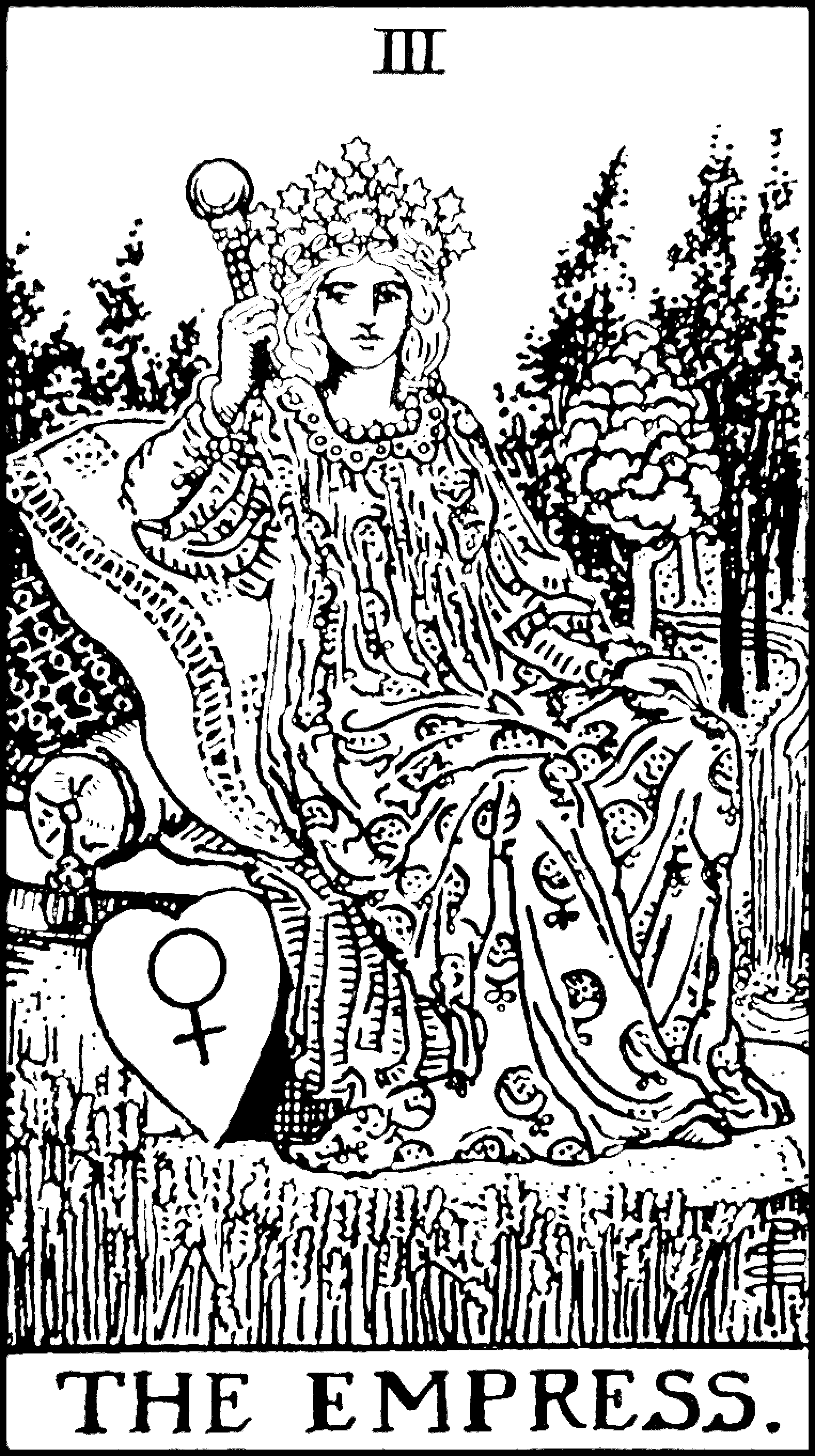
This week we pulled the The Empress. Here we have the All-Nurturing Power; that which engenders all creativity. This is the “daughter of heaven and earth” — “Nature” writ large. This is the life giving, but also life taking, and life dispersing force. Be in tune with this force’s greater powers, and occasionally your individuality/influence will be allowed to flourish — but do not be disrespectful by way of being self important, or hell could be in store.
Our first hexagram this week is #4, Youthful Folly. “…the youth… must be conscious of their lack of experience and must seek out the teacher. Without this modesty and this interest there is no guarantee that they will have the necessary receptivity, which should express itself in respectful acceptance of the teacher. This is the reason why the teacher must wait to be sought out instead of offering themself. Only thus can the instruction take place at the right time and in the right way.” So yes, there is here the famous proverb: the student must seek the teacher (not the other way around) but also it could be said this way, education is being patient (and modest) for a sincere question to meet a sincere answer.
There was one change this week of which the specific note is: “In times of general dispersion and separation, a great idea provides a focal point for the organization of recovery”.
Our second hexagram or how best to meet the changes is #59, Dispersion (Dissolution). “When a person’s vital energy is dammed up within them… gentleness serves to break up and dissolve the blockage.” “Here the subject is the dispersing and dissolving of divisive egotism.” “In the autumn and winter, water begins to freeze into ice. When the warm breezes of spring come, the rigidity is dissolved, and the elements that have been dispersed in ice floes are reunited.” “Through hardness and selfishness the heart grows rigid, and this rigidity leads to separation from all others. Egotism and cupidity isolate people. Therefore the hearts of people must be seized by a devout emotion… must be shaken by awe in face of eternity.” A dissolution that reconstitutes the individual — like a breaking apart of a biased clinging, so as to have a humble but deep appreciation of both cosmos and self. To stimulate such an attitude, it is suggested to visit a personage or place of significant majesty (like visiting a holy person or climbing a mountain) or engaging a scenario of true selflessness (like helping to build something of civic significance, etc.).
- Try to understand what relinquishing to the higher power/force of “nature” means.
- Do not be disrespectful to anything (any thing).
- The student must seek the teacher (not the other way around).
- Dissolve your clinging biases (whether aimed at the self or externally) — to start, engage scenarios clearly greater than self (climb a mountain, visit a “holy” person, volunteer selflessly).
- Reconstitution out of dispersion requires the organizing focus of a beautiful/idealistic/aspirational image.
From “K”: Is it worth exploring the age-old question of determinism vs free will when reflecting on frustrating patterns of greed, domination and power pervasive in modern culture. From conflicts playing out through global political institutions to subtler displays of dominance in day-to-day interaction, how much blame can be put on individuals who are acting out defenses etched in the subconscious since early childhood (that they are most likely unaware of)? The heavy word responsibility comes to mind but does not hold much weight when we take into account external influences and subconscious drives.
Thank you for your question.
“Forces” “will” “patience” and “clinging” are the themes returned for you.
The world of humans has always been in the clutch of greedy people and we masses have always been, and most likely will be, ignorant/unconscious of the detrimental effects of our behavior. So yes, what to do? (“Age old” indeed.)
It seems patient, self-improving, relinquishment is in order.
In this light, and specifically regarding the context of your situation, are you the curious student seeking the teacher? Or are you the patient teacher that can only deliver that which is sought? Those are the only two healthy scenarios.
You are likely the student in some situations and the teacher in others. Try never to get those roles mixed up — and we mean this in the deepest way TAKE PAINS not to get those roles mixed up; it can cause years of confusion and suffering.
When you are the teacher you should simply focus on the ideals you know to be beautiful and true (if anyone says “truth” is bullshit, because it is conditional, know that they are something like a devil). They don’t know that you know that the truth of life is unknowable and that you know that it is something like a matter of developing gratitude and developing a transcendental curiosity...
When you are the student, search in humbleness. Don’t accept the falsity of negative or positive coercions.
It is ok to laugh/cry through this endlessly wicked, endlessly beautiful world — just try and do it with patience.
Complete Reading
This week we pulled the The Empress. Here we have the All-Nurturing Power; that which engenders all creativity. This is the “daughter of heaven and earth” — “Nature” writ large. This is the life giving, but also life taking, and life dispersing force. Be in tune with this force’s greater powers, and occasionally your individuality/influence will be allowed to flourish — but do not be disrespectful by way of being self important, or hell could be in store.
Our first hexagram this week is #4, Youthful Folly. “…the youth… must be conscious of their lack of experience and must seek out the teacher. Without this modesty and this interest there is no guarantee that they will have the necessary receptivity, which should express itself in respectful acceptance of the teacher. This is the reason why the teacher must wait to be sought out instead of offering themself. Only thus can the instruction take place at the right time and in the right way.” So yes, there is here the famous proverb: the student must seek the teacher (not the other way around) but also it could be said this way, education is being patient (and modest) for a sincere question to meet a sincere answer.
There was one change this week of which the specific note is: “In times of general dispersion and separation, a great idea provides a focal point for the organization of recovery”.
Our second hexagram or how best to meet the changes is #59, Dispersion (Dissolution). “When a person’s vital energy is dammed up within them… gentleness serves to break up and dissolve the blockage.” “Here the subject is the dispersing and dissolving of divisive egotism.” “In the autumn and winter, water begins to freeze into ice. When the warm breezes of spring come, the rigidity is dissolved, and the elements that have been dispersed in ice floes are reunited.” “Through hardness and selfishness the heart grows rigid, and this rigidity leads to separation from all others. Egotism and cupidity isolate people. Therefore the hearts of people must be seized by a devout emotion… must be shaken by awe in face of eternity.” A dissolution that reconstitutes the individual — like a breaking apart of a biased clinging, so as to have a humble but deep appreciation of both cosmos and self. To stimulate such an attitude, it is suggested to visit a personage or place of significant majesty (like visiting a holy person or climbing a mountain) or engaging a scenario of true selflessness (like helping to build something of civic significance, etc.).