Jan 07 25
Strength

26. The Taming Power of the Great
These first few lines are the general aphoristic returns for the week. They are raw and uninterpreted; there to use how you’d like. (The specific readings follow.)
From “M.S.”: If you asked anyone, they would likely say that they hate corporate surveys — probably would even say that they’d never shill or degrade themselves to contribute to the coffers of dark, parasitic, and vile executives — but is that really true? It seems this is only true when the activity happens directly or in the open — if it goes without external, judging witnesses, detachment from one’s promoted morality seems to have no end.
It’s like what Gary Indiana said: “What we do in the dark is what defines us, not the postures we assume when the light shines down.”
So yes, on the web, every second, everyone is handing over the most detailed information about themselves, mostly without prompting, and with almost zero protest (sexual inclinations, shopping habits, political views, all manner of health and biographical/locational information, sleep/work/procrastination habits) — creating power structures and mental pollution on par with a daily oil spill. It seems convenience and risk-less pretending trumps actual, real defiance. We suspect that we humans are no match against the transcendental economy of short term comfort and ease to take on large momentums? Please advise.
Recently, an excerpt of an interview with painter Agnes Martin has resurfaced in our life. Much of it sounds like it might be a bit of a put on, by way of being simultaneously radical and weirdly straight forward. Some of her statements have become sort of thought worms for us. An example:
...I don’t believe what the intellectuals put out. The intellectuals discover one fact and then another fact and then another and they say from all these facts we can deduce so-and-so. No good. That’s just a bad guess. Nothing can come but inaccuracy...
One of the secret (or perhaps suppressed) principles of past knowledge is that human learning is a sequence of paradigm shifts — one makeshift center after another.
Your observation is ultimately a cottage industry type thought off of a paradigm shift. You should develop a style of personal fortitude (reinforced daily) with the intention to thrive without general stable physics — part of such an endeavor will look like relenting to higher forces (note: we did not say “higher powers” but forces — for that would be idolatrous, or as Martin might say, inaccurate).
Complete Reading
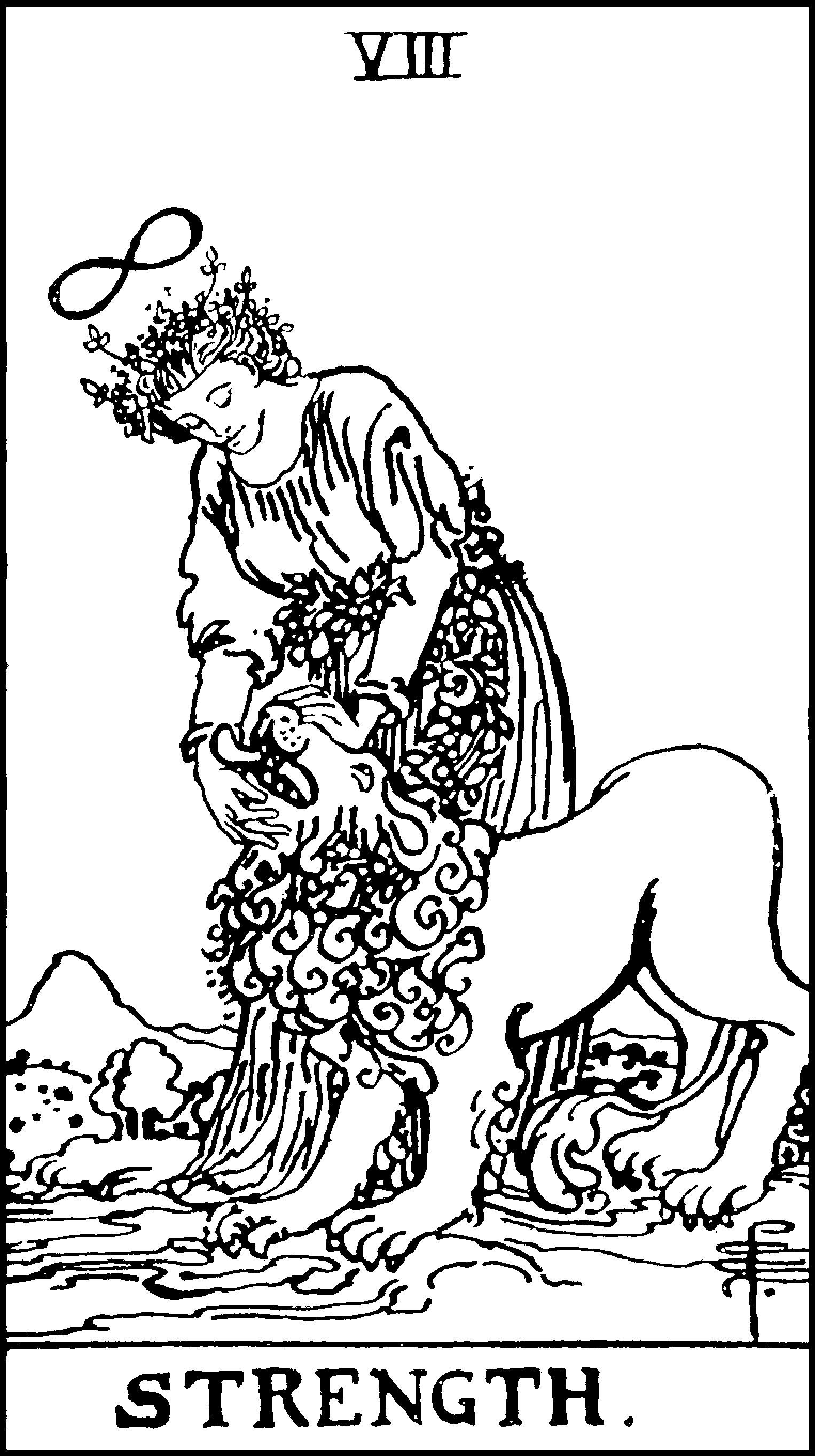
This week we pulled the Strength card. Here we have fortitude, the perseverance through difficulty/pain. This type of strength is connected to the primordial powers — it is said that endurance of this kind is a relinquishment to these prime movers. Contemplation is also an aspect here.
Our first and only hexagram this week is 26, The Taming Power of the Great. To develop as a person of “light and clarity” one must participate in a “daily renewal of character. Only through daily self–renewal can a person continue at the height of their powers.” It is suggested that the heart of this daily renewal lies “in the words and deeds of the past… a treasure that people may use to strengthen and elevate their own characters.” However “the way to study the past is not to confine oneself to mere knowledge of history but, through application of this knowledge, to give actuality to the past.”
- Develop a practice of contemplation that is a form of relinquishment to forces larger than yourself.
- One must participate in a daily renewal of character.
- Apply, not merely study, the knowledge of the past.
From “M.S.”: If you asked anyone, they would likely say that they hate corporate surveys — probably would even say that they’d never shill or degrade themselves to contribute to the coffers of dark, parasitic, and vile executives — but is that really true? It seems this is only true when the activity happens directly or in the open — if it goes without external, judging witnesses, detachment from one’s promoted morality seems to have no end.
It’s like what Gary Indiana said: “What we do in the dark is what defines us, not the postures we assume when the light shines down.”
So yes, on the web, every second, everyone is handing over the most detailed information about themselves, mostly without prompting, and with almost zero protest (sexual inclinations, shopping habits, political views, all manner of health and biographical/locational information, sleep/work/procrastination habits) — creating power structures and mental pollution on par with a daily oil spill. It seems convenience and risk-less pretending trumps actual, real defiance. We suspect that we humans are no match against the transcendental economy of short term comfort and ease to take on large momentums? Please advise.
Recently, an excerpt of an interview with painter Agnes Martin has resurfaced in our life. Much of it sounds like it might be a bit of a put on, by way of being simultaneously radical and weirdly straight forward. Some of her statements have become sort of thought worms for us. An example:
...I don’t believe what the intellectuals put out. The intellectuals discover one fact and then another fact and then another and they say from all these facts we can deduce so-and-so. No good. That’s just a bad guess. Nothing can come but inaccuracy...
One of the secret (or perhaps suppressed) principles of past knowledge is that human learning is a sequence of paradigm shifts — one makeshift center after another.
Your observation is ultimately a cottage industry type thought off of a paradigm shift. You should develop a style of personal fortitude (reinforced daily) with the intention to thrive without general stable physics — part of such an endeavor will look like relenting to higher forces (note: we did not say “higher powers” but forces — for that would be idolatrous, or as Martin might say, inaccurate).
This week we pulled the Strength card. Here we have fortitude, the perseverance through difficulty/pain. This type of strength is connected to the primordial powers — it is said that endurance of this kind is a relinquishment to these prime movers. Contemplation is also an aspect here.
Our first and only hexagram this week is 26, The Taming Power of the Great. To develop as a person of “light and clarity” one must participate in a “daily renewal of character. Only through daily self–renewal can a person continue at the height of their powers.” It is suggested that the heart of this daily renewal lies “in the words and deeds of the past… a treasure that people may use to strengthen and elevate their own characters.” However “the way to study the past is not to confine oneself to mere knowledge of history but, through application of this knowledge, to give actuality to the past.”