Oct 01 24
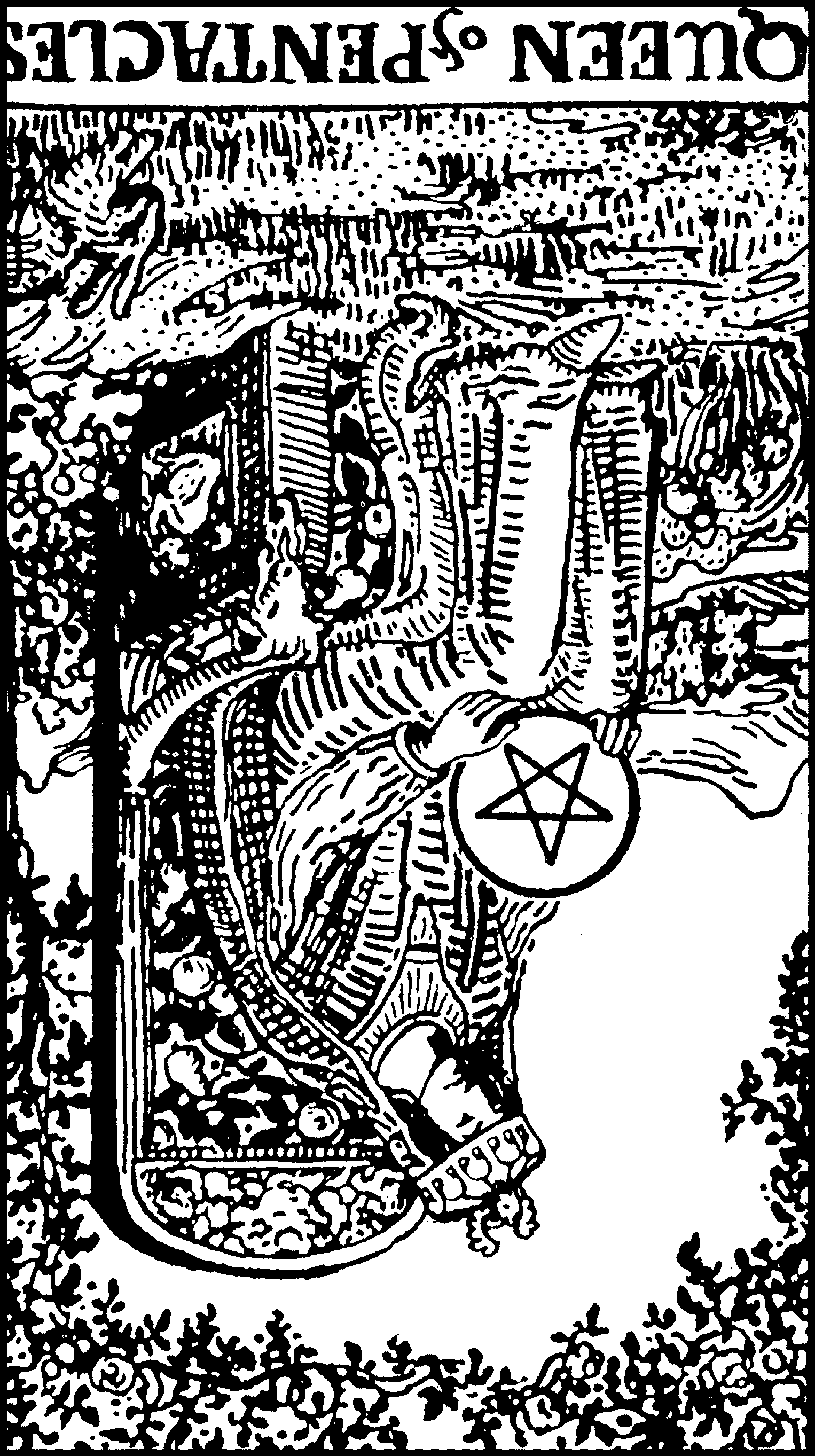
Queen of Pentacles (reversed)

39. Obstruction
37. The Family [The Clan]
These first few lines are the general aphoristic returns for the week. They are raw and uninterpreted; there to use how you’d like. (The specific readings follow.)
From “M.S.”: It is perhaps embarrassing by way of being on the nose or an obvious question to ask the Book of Changes(and has likely been asked before) but what is the best way to handle change? We want to be sophisticated about managing the mad novelty that is always coming and blowing apart our world(s) — that is, we would like to be durably kind and sensitive as regards our interaction with all assaulting difference whether short, middle, or long-term. We remember Crowley saying something like the price of transformation is eternal vigilance — which, from our current standpoint, sounds hard (both in the sense of difficulty and in the sense of needing to be indelicate of emotion). Is there nothing that can be done except vigilance in the face of change? As well, is our desire for intelligent kindness just masked laziness? Do we just have to accept that some change requires raving, whilst others are best met with the proverbial stiff upper lip? Sorry again for the possible prosaic-ness — nevertheless please help/advise.
In a very real way we are all centers. But also, in a very real way we are all false centers. With the latter we are attempting to speak to the limitations of human perspective, with the former, we are insinuating that most influence really comes from within. Yes it is true that we are set in motion by the imprinting of difficult (or worse) childhood events, but all people still experience (and subsequently behave) by weighing things in the hermetically sealed place of our own heads. All is change, not sometimes is change.
We are all storms within larger storms — but it is necessary not to have a totally dark outlook — you can trick your brain (you’re brain is a kind of trick afterall). Obviously we understand this may sound very weird.
Complete Reading
This week we pulled the Queen of Pentacles (reversed). When upright the card indicates a healthy broad intellect and a gift for fertile contemplation. When reversed as it is here, the emphasis is on highly negative cunning — a dark outlook with dark plans.
Our first hexagram this week is #39, Obstruction. This hexagram is a meditation on obstacles; how if approached in a positive spirit, a hindrance can be an opportunity for growth — a set back pack is training for next time. “The inferior person seeks to put the blame on others, bewailing their fate. The superior person seeks the error within themself, and through this introspection the external obstacle becomes an occasion for inner enrichment and education.”
There were two changes this week of which the specific notes are: danger avoided should be taken as welcome notice andthere are times when long term, intelligent retreat needs to be overcome into a return to action (call this a return to duty).
Our second hexagram, the one that suggests how best to meet the challenges (or the changes) is #37, The Family (The Clan). “The family is society in embryo...” Though much has changed gender-wise (etc.) since the ancient Chinese world of the I Ching, the essence of this line holds true — whatever a family unit may be to someone. Behavior is fractal, if a core structure is insecure or lazy or strong or flexible or sensitive — the quality will radiate out (or leach) elsewhere. One must struggle to be honest with oneself first and foremost in this world, then with those closest to you. “Influence on others must proceed from one’s own person… one’s words must have power, and this they can have only if they are based on something real… if words and conduct are not in accord and not consistent, they will have no effect.”
- The danger of intellect is that it can be deviously employed — if one is intelligent they must take measures to use it righteously (as in, Gandalf didn’t allow himself to hold the ring).
- Obstacles are practice for overcoming them.
- Influence starts with the self.
- Even hermits may rightly be called upon to return to action.
- “The family” and or “the self” is “society in embryo” — their stability and health radiates outward, fractally.
From “M.S.”: It is perhaps embarrassing by way of being on the nose or an obvious question to ask the Book of Changes(and has likely been asked before) but what is the best way to handle change? We want to be sophisticated about managing the mad novelty that is always coming and blowing apart our world(s) — that is, we would like to be durably kind and sensitive as regards our interaction with all assaulting difference whether short, middle, or long-term. We remember Crowley saying something like the price of transformation is eternal vigilance — which, from our current standpoint, sounds hard (both in the sense of difficulty and in the sense of needing to be indelicate of emotion). Is there nothing that can be done except vigilance in the face of change? As well, is our desire for intelligent kindness just masked laziness? Do we just have to accept that some change requires raving, whilst others are best met with the proverbial stiff upper lip? Sorry again for the possible prosaic-ness — nevertheless please help/advise.
In a very real way we are all centers. But also, in a very real way we are all false centers. With the latter we are attempting to speak to the limitations of human perspective, with the former, we are insinuating that most influence really comes from within. Yes it is true that we are set in motion by the imprinting of difficult (or worse) childhood events, but all people still experience (and subsequently behave) by weighing things in the hermetically sealed place of our own heads. All is change, not sometimes is change.
We are all storms within larger storms — but it is necessary not to have a totally dark outlook — you can trick your brain (you’re brain is a kind of trick afterall). Obviously we understand this may sound very weird.
Complete Reading
This week we pulled the Queen of Pentacles (reversed). When upright the card indicates a healthy broad intellect and a gift for fertile contemplation. When reversed as it is here, the emphasis is on highly negative cunning — a dark outlook with dark plans.
Our first hexagram this week is #39, Obstruction. This hexagram is a meditation on obstacles; how if approached in a positive spirit, a hindrance can be an opportunity for growth — a set back pack is training for next time. “The inferior person seeks to put the blame on others, bewailing their fate. The superior person seeks the error within themself, and through this introspection the external obstacle becomes an occasion for inner enrichment and education.”
There were two changes this week of which the specific notes are: danger avoided should be taken as welcome notice andthere are times when long term, intelligent retreat needs to be overcome into a return to action (call this a return to duty).
Our second hexagram, the one that suggests how best to meet the challenges (or the changes) is #37, The Family (The Clan). “The family is society in embryo...” Though much has changed gender-wise (etc.) since the ancient Chinese world of the I Ching, the essence of this line holds true — whatever a family unit may be to someone. Behavior is fractal, if a core structure is insecure or lazy or strong or flexible or sensitive — the quality will radiate out (or leach) elsewhere. One must struggle to be honest with oneself first and foremost in this world, then with those closest to you. “Influence on others must proceed from one’s own person… one’s words must have power, and this they can have only if they are based on something real… if words and conduct are not in accord and not consistent, they will have no effect.”